
A multination project to build a fusion reactor cleared a milestone yesterday and is now 6 ½ years away from “First Plasma,” officials announced.
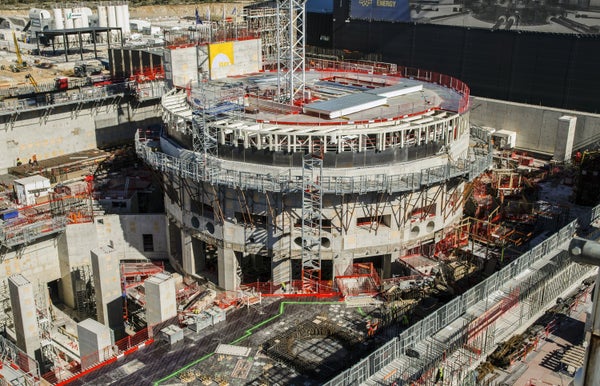
Yesterday, dignitaries attended a components handover ceremony at the construction site of the International Thermonuclear Experimental Reactor in southern France. The ITER project is an experiment aimed at reaching the next stage in the evolution of nuclear energy as a means of generating emissions-free electricity.
The section recently installed—the cryostat base and lower cylinder—paves the way for the installation of the tokamak, the technology design chosen to house the powerful magnetic field that will encase the ultra-hot plasma fusion core.
On supporting science journalism
If you're enjoying this article, consider supporting our award-winning journalism by subscribing. By purchasing a subscription you are helping to ensure the future of impactful stories about the discoveries and ideas shaping our world today.
“Manufactured by India, the ITER cryostat is 16,000 cubic meters,” ITER officials said in a release. “Its diameter and height are both almost 30 meters and it weighs 3,850 tons. Because of its bulk, it is being fabricated in four main sections: the base, lower cylinder, upper cylinder, and top lid.”
The entire project is now 65% complete, the officials said.
The world’s first commercial-scale fusion reactor project is on track to officially launch operations at the end of 2025, said spokeswoman Sabina Griffith, but it will take at least a decade to fully power up the facility.
“The date for First Plasma is set; we will push the button in December 2025,” Griffith said. “It will take another 10 years until we reach full deuterium-tritium operations.”
Thirty-five nations are cooperating on the project to bring fusion power to the masses.
Achieving controlled fusion reactions that net more power than they take to generate, and at commercial scale, is seen as a potential answer to climate change. Fusion energy would eliminate the need for fossil fuels and solve the intermittency and reliability concerns inherent with renewable energy sources. The energy would be generated without the dangerous amounts of radiation that raises concerns about fission nuclear energy.
Officials say the ITER nuclear fusion reactor is poised to be the most complicated piece of machinery ever built. It will contain the world’s largest superconducting magnets, needed to generate a magnetic field powerful enough to contain a plasma that will reach temperatures of 150 million degrees Celsius, about 10 times hotter than the center of the sun.
Griffith said more milestones will be cleared as soon as construction continues.
“We will see the arrival of the first major Tokamak components like the first PF Coil from China (a European contribution), a Vacuum Vessel sector from Korea and first TF coils (from Europe and Japan) this autumn,” Griffith said in an email. “This will lead us to the official start of assembly in spring next year.”
Reprinted from Climatewire with permission from E&E News. E&E provides daily coverage of essential energy and environmental news at www.eenews.net.