New Issue: Orbital Catastrophe Ahead? Read Now

This Cave Holds a Spider Web ‘Megacity’ the Size of Half a Tennis Court

This finding is the first documented case of colonial behavior between two solitary species of spider

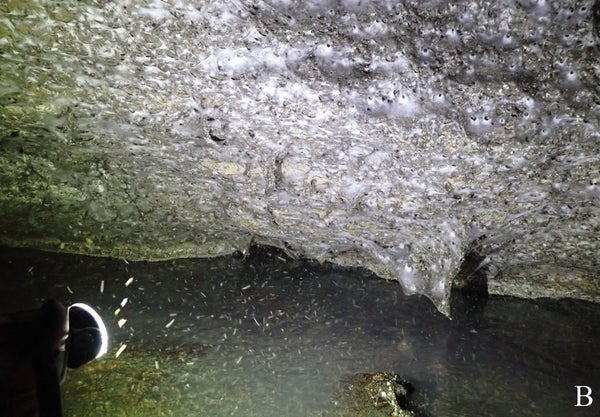
A section of cave rock completely covered by film white spider web

Lights illuminate a massive spider web found in a cave on the border of Greece and Albania.

“An Extraordinary Colonial Spider Community in Sulfur Cave (Albania/Greece) Sustained by Chemoautotrophy,” by István Urák et al., in Subterranean Biology, No. 53. Published online October 17, 2025 (CC BY 4.0)

Join Our Community of Science Lovers!

While exploring a sulfur cave on the Albania-Greece border, scientists at the Czech Speleological Society discovered the largest spider web ever recorded. The vast “megacity,” spanning more than 1,040 square feet —nearly half the size of a tennis court—is home to about 111,000 spiders of the species Tegenaria domestica and Prinerigone vagans, according to a study by a separate group of researchers. This is the first documented case of either of these two species constructing webs together, the study’s authors reported recently in Subterranean Biology.
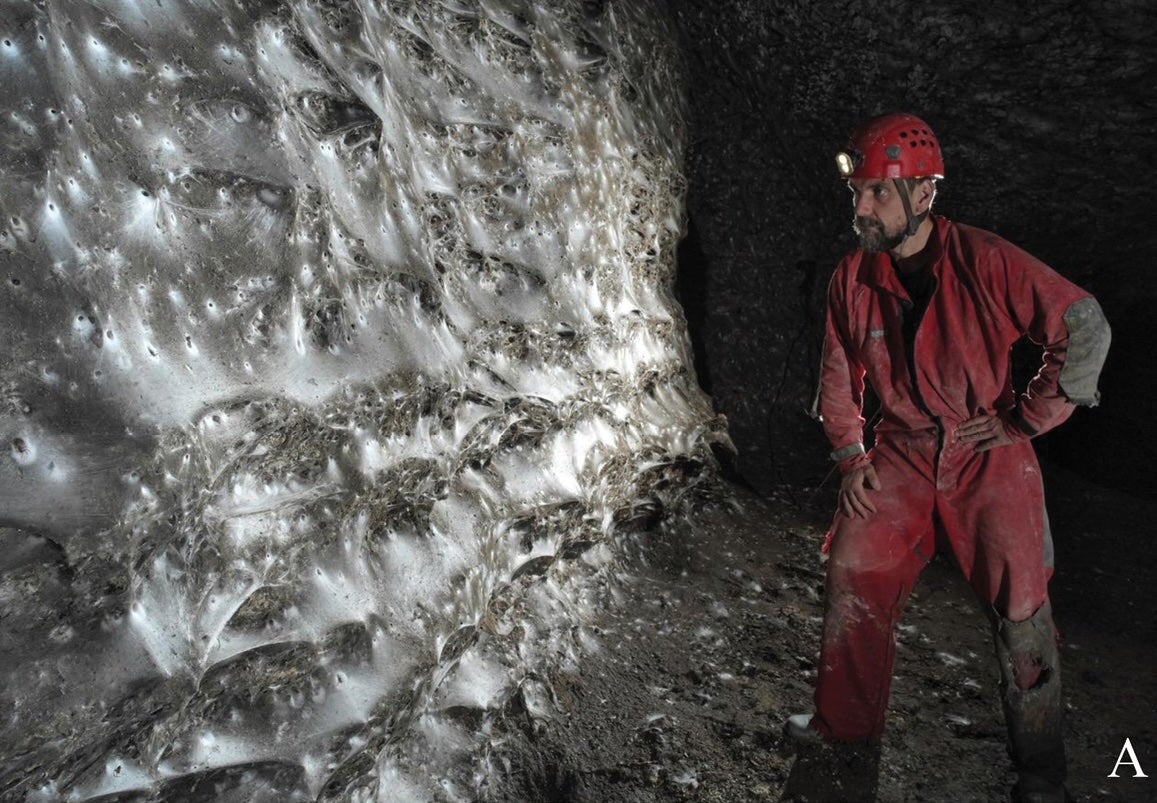
A caver in a red jumpsuit and helmet stand on the right, his headlamp illuminates the giant spider web on the cave all in front of him

A caver looks at the massive colonial spider web.

Marek Audy

Sulfur caves are among the most extreme habitats on Earth. They are completely dark and filled with hydrogen sulfide gas, which is toxic to most life-forms. Inside, species’ survival depends on chemical reactions powered by microbes that oxidize sulfur. These microorganisms are the base of a unique food chain that supports a community of cave-dwelling organisms.


On supporting science journalism

If you're enjoying this article, consider supporting our award-winning journalism by subscribing. By purchasing a subscription you are helping to ensure the future of impactful stories about the discoveries and ideas shaping our world today.


To understand how the spiders survive in this environment, the team analyzed the chemical signatures in their tissues, which revealed that the arachnids feed on tiny midges that hatch from cave pools. Those flies themselves depend on sulfur-oxidizing microbes as their primary food source.

Spider on a filmy white web on top of cave rock

Tegenaria domestica on the spider web.

“An Extraordinary Colonial Spider Community in Sulfur Cave (Albania/Greece) Sustained by Chemoautotrophy,” by István Urák et al., in Subterranean Biology, No. 53. Published online October 17, 2025 (CC BY 4.0)

A genetic analysis showed that the cave-dwelling spiders are becoming distinct from populations of the same species that live outside, suggesting they are adapting to the underground environment, the researchers wrote. They think that this genetic isolation, combined with a stable and abundant food supply, may have driven these species—which have never been reported to form colonies—to evolve colonial behavior.

The new finding “shows that nature still holds many surprises for us,” says study co-author Urák István of the Sapientia Hungarian University of Transylvania in Romania.

Humberto Basilio is a Mexican science journalist covering policy, health, misconduct, archaeology and the environment. He is also a former news intern at Scientific American. His work has been published in the New York Times, National Geographic, Science, Nature, and more.

More by Humberto Basilio

Subscribe to Support Independent Journalism

Great science journalism requires human expertise, time, effort and creativity. And it costs money. That’s why I and the journalists here at Scientific American hope you’ll join our community.

When you subscribe, you are supporting staff and freelance journalists who are passionate about telling science stories that are true, important and compelling. Our editors and reporters are often experts in their fields, which means they understand the nuances of big discoveries and can untangle the breakthroughs from the hype. With a subscription, you are also supporting rigorous fact-checking to ensure the words we publish are precise and accurate. And you’re supporting original illustrations, graphics and photos that bring you closer to an advanced laboratory, an ice sheet in Antarctica or a space mission in orbit. You’re helping us craft other types of high-quality journalism as well: Our newsletters are carefully written, edited and curated by staffers you have or will come to know and love. Our Science Quickly podcast is based on original reporting, collaboration with editors and scientists and exacting production.

Subscriptions keep this engine running so we can continue to deliver thoughtful, rigorous and independent science journalism to you. In an era of viral misinformation, this work is crucial. If you value what we do, I hope you’ll consider joining us as a subscriber

Thank you,

Jeanna Bryner, Editor in Chief, Scientific American

Subscribe