
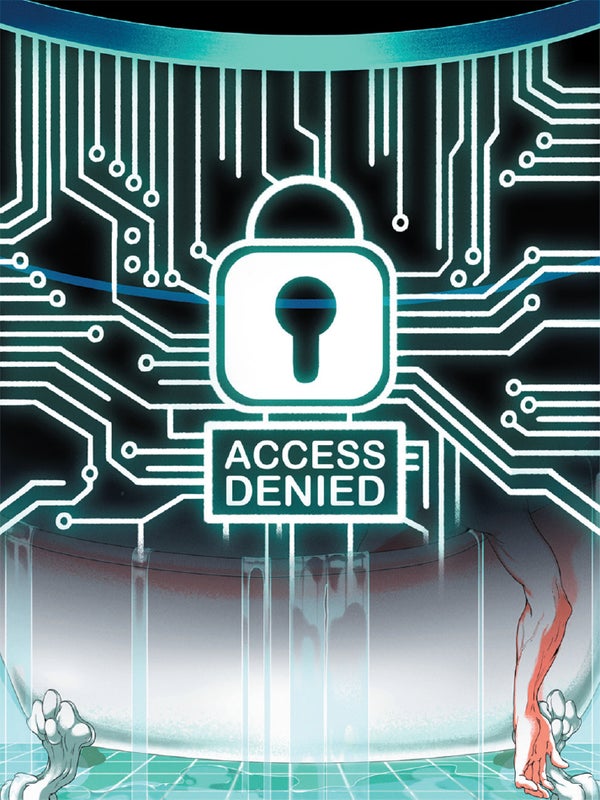
In November 2015 James Bates invited some friends over to watch a Razorbacks football game at his house in Bentonville, Ark. The next morning one of them, Victor Collins, was found dead in Bates's hot tub—apparently strangled. Bates was charged with murder; he pled not guilty. But in their investigation, the police discovered something intriguing. He had an Amazon Echo, the popular black cylinder that's always listening for voice commands and questions, something like Siri for the home.
The police served Amazon with a search warrant. Their hope: to retrieve recordings the Echo might have made on that fateful night, with clues to what happened. That's a mighty slim hope. The Echo is indeed listening all the time but only for the word “Alexa,” which you must utter at the beginning of any request. No audio is recorded or transmitted until you do so. At that point, the Echo's bright blue LED lights up while your request is sent to Amazon's computers for an answer. But very occasionally the Echo thinks it hears “Alexa” and responds nonsensically to whatever sentence comes next. If that freak occurrence happened on the night of the murder, then maybe the police could retrieve a few seconds of audio.
But never mind. Amazon gave them the customer's subscriber and purchase information but refused to supply any recordings or data that pertained to what Bates said to his Echo. “Amazon objects to overbroad or otherwise inappropriate demands as a matter of course,” the company said in a statement. Between the lines, you can sort of hear: “If the public thinks that we record conversations in their homes and make them available to law enforcement, that's the end of our Echo product line!”
On supporting science journalism
If you're enjoying this article, consider supporting our award-winning journalism by subscribing. By purchasing a subscription you are helping to ensure the future of impactful stories about the discoveries and ideas shaping our world today.
That's not the first time a big electronics company has refused to cooperate with the law on privacy grounds. You may recall that last year the FBI asked Apple to give it backdoor access to the San Bernardino shooter's iPhone, and Apple refused. (The FBI was able to gain access to the phone's data through other means.)
In the Arkansas case, the police ended up striking possible gold, not with the Echo but with Bates's smart water meter. Its records revealed that someone used 140 gallons of water between 1 and 3 A.M. the night of the murder. Investigators doubt that Bates took a really long shower; instead they believe that he used the water to rinse away evidence on his patio.
Legally, of course, Amazon could land in some hot water of its own. “Amazon risks being held in contempt of court for its refusal to comply fully,” says Peter Guffin, who heads up the privacy and data security practice at law firm Pierce Atwood. “If the parties are unable to reach an agreement for obtaining the data, a contempt proceeding could be commenced against Amazon.”
That, in fact, is exactly where things stand. As I write this, Nathan Smith, the attorney for the Bates prosecution, has told me that the case will likely go to trial later this year and that his office still hopes to work something out with Amazon. But if the company refuses to budge, he may have to take it to court.
These conflicts will only become more frequent. At this year's enormous International Consumer Electronics Show in Las Vegas, the hottest trend was Echo compatibility. An astonishing number of newly unveiled appliances can respond to commands you speak to your Echo: refrigerators, light switches, power strips, lamps, speakers, robotic vacuums, satellite boxes, TVs, security cameras, door locks, air purifiers, washers and dryers, cars, and on and on.
As we fill our homes with machines that are always listening or watching, clashes between electronic privacy and law enforcement will occur ever more frequently. “There are no laws that govern this,” Guffin says. “We haven't enacted laws that deal with this burgeoning array: the movements in our house, what we're putting in our refrigerators, how much energy we're using, the conversations we might be having in our homes.” Dear lawmakers: The Internet of Listening Things is now upon us. Might be worth looking into.