
This article was published in Scientific American’s former blog network and reflects the views of the author, not necessarily those of Scientific American
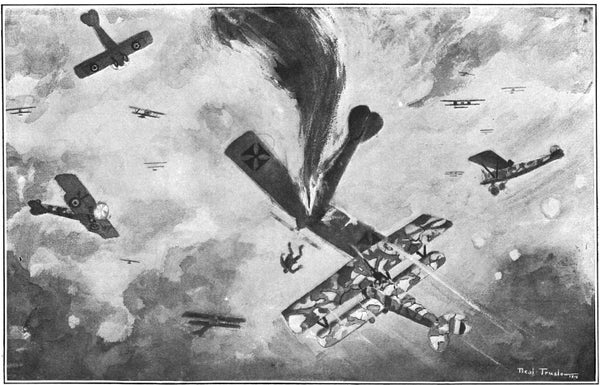
The cover of the Scientific American issue from exactly 100 years ago today has an image that I suspect is supposed to fill the reader with horror: an aviator has fallen out of his aircraft, and in an era before parachutes were issued to pilots, the fate of this person is grim indeed. The article is a first-person account, apparently of an engagement between German pilots and American pilots in the Escadrille Américaine (“American Squadron,” later renamed the Lafayette Squadron after complaints from the Germans about a military unit named for a still-neutral country). The article is probably true given that the American Squadron fought near Verdun between May and September of 1916 and the author of the article was at this time apparently working with the American ambulance corps near that battlefield. The article from 100 years ago today begins:
“Sheltered by a woods some two miles back of the German trenches at Verdun, a 75 mm. antiaircraft gun was active. The men worked rapidly but surely. The gun was firing a shell every five seconds, and every five seconds a little puff of white smoke appeared in the sky. At first glance I wondered what the object of such activity was, but observing more closely could distinctly see a German Aviatik apparently enveloped in the smoke of the exploding shells, but in reality some distance above it. Lieutenant Hangarer, in charge of the gun, loaned me his glasses [binoculars] for a moment. I then saw not one but a number of the large German planes headed toward our lines. These were convoyed by several Fokkers, which are the fastest German aeroplane used for combat and scouting purposes....
Lieutenant Hangarer spoke to me as the Germans fiew out of range of our gun: "You see those little Nieuports up there? They are the American Squadrille and a wonderful unit! ...
On supporting science journalism
If you're enjoying this article, consider supporting our award-winning journalism by subscribing. By purchasing a subscription you are helping to ensure the future of impactful stories about the discoveries and ideas shaping our world today.
The attack had come as no great surprise. For two days the French had been bringing in great quantities of fresh troops. Heavy artillery had been brought up and the light artillery shifted. It was quite apparent that the French were planning a concentrated attack on the right bank of the Meuse. German air scouts had discovered this movement and were trying desperately to ascertain its force. Particularly were they anxious to locate the position of the artillery that they might prepare for a counter attack....
Suddenly a little puff of black smoke enveloped a machine. The gasoline tank had been punctured and caught fire. The plane darted to earth leaving a thin black streak behind it. At that great height we could not tell to which side the machine belonged. In a few moments the group around the gun began to cheer and I heard excited cries of ‘C'est tombe! C'est tombe! C'est un Bosche!’ The Americans had scored. It was a German Aviatik that had fallen.”
The cover image this week was painted and reported by Neal Truslow, who wrote several articles for Scientific American while in France in 1915 and 1916. Truslow had been living in New York and was a member of the Art Student’s League, but in May 1915 went to France to paint and report on conditions there. In September 1915 he felt compelled to volunteer with the American ambulance corps and started assisting evacuating wounded from the front lines near Verdun. The biographical information on Truslow comes with thanks from the “Fleeter Than Horses” blog.
-
Our full archive of the war, called Scientific American Chronicles: World War I, has many articles from 1914–1918 on warfare on the Western Front in the First World War. It is available for purchase at www.scientificamerican.com/products/world-war-i/