
This article was published in Scientific American’s former blog network and reflects the views of the author, not necessarily those of Scientific American
The United States was outraged. Its civilian ships were being targeted and sunk by torpedoes or mines as Germany sought to choke off the trans-Atlantic flow of supplies to its enemies. American civilians were killed. As these hostile acts propelled the U.S. and Germany toward open warfare in early 1917, there was also a pervasive fear that the outbreak of war might be announced by these same submarines sneaking into U.S. harbors and sinking the American fleet at anchor.

Advertisement in an issue of Scientific American from 100 years ago today, drumming up support for the U.S. Naval Reserve. Boat owners and boats were desperately wanted for use as protection of the coast against prowling enemy submarines. Credit: Scientific American, March 31, 1917
In an age before underwater or surface detection electronics such as sonar and radar, and before effective depth charges were widely deployed, there were few things a surface ship could do to fight back against a submarine. But diesel-electric submarines had two major weaknesses: when they were submerged they travelled quite slowly on battery power; and they needed to surface to allow the diesel engines to recharge the batteries. (Nuclear submarines have neither of these weaknesses, which is why they are so useful as warships.)
On supporting science journalism
If you're enjoying this article, consider supporting our award-winning journalism by subscribing. By purchasing a subscription you are helping to ensure the future of impactful stories about the discoveries and ideas shaping our world today.
It was thought that a widespread net of surface ships could either catch submarines on the surface or force them to remain submerged, limiting their capabilities. Enter the “submarine swatter”: a small, fast, lightly armed motor boat. One small shell fired from one of these boats could prevent a submarine from submerging—and thereby end its mission, perhaps permanently. By 1916 the U.S. had started building these submarine chasers and was also designating private yachts as boats that could be used by the U.S. Naval Reserve. After the U.S. entered the war the submarine chaser had become a standardized 110-foot, 85-ton, seaworthy boat.
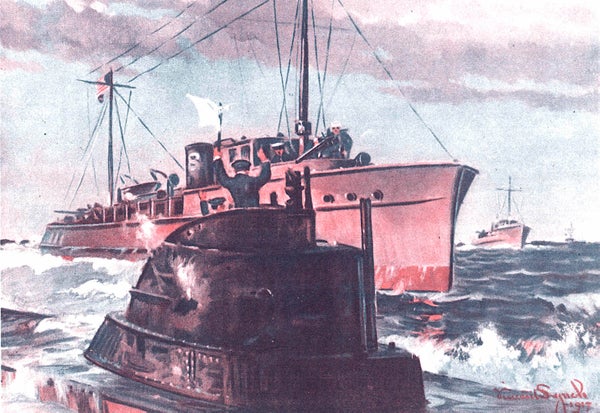
This week’s image shows a satisfying result for one of these chasers—although both chaser and submarine were American and working on naval maneuvers. There is also an advertisement for civilian motor yachts—and their owners—to join the navy as reservists.
-
The views expressed are those of the author and are not necessarily those of Scientific American.
Our full Archive from 1845 to today, has many articles from 1914 to 1918 on naval warfare—or just the fear of it—during the First World War. It is available for purchase at www.scientificamerican.com/magazine/sa