
This article was published in Scientific American’s former blog network and reflects the views of the author, not necessarily those of Scientific American
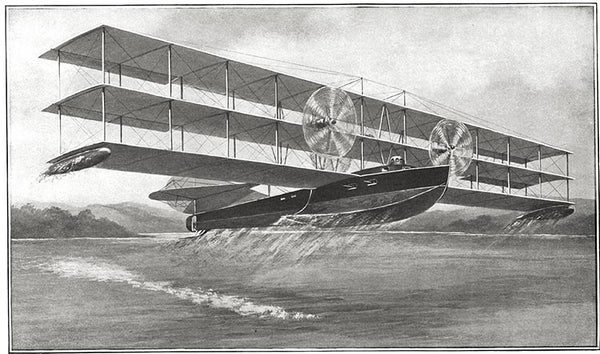
As the year 1915 came to a close, Scientific American published an article on a new, and somewhat unrealistic, design for a seaplane. At the time it seemed as if this new airplane was merely an evolution of current military trends:
“Aircraft construction, however, develops along the very lines of evolution which have been, and still are, the law for vessels of war, and which can be summarized in one word: bigger!”
Described as a “battleship airplane” and a “huge hydroaeroplane,” it was supposed to have a 133-foot wing span, six 160 horsepower engines, and a gross takeoff weight of 21,450 pounds. It would have been comparable in size, weight and armament with twin-engined bombers of World War II (although with only a fraction of their speed, range and bomb load).
On supporting science journalism
If you're enjoying this article, consider supporting our award-winning journalism by subscribing. By purchasing a subscription you are helping to ensure the future of impactful stories about the discoveries and ideas shaping our world today.
The Curtiss Aeroplane Company at Buffalo designed this airplane. By 1915 this firm was already well-established in supplying the British Royal Navy with exceptionally useful large long-range seaplanes (a few hundred by the end of the war) for patrol work, anti-submarine use, and search and rescue operations. This particular airplane was never adopted. I do not know why, but the triplane design looks archaic; the six engines and three propellers were arranged seemingly haphazardly (two pairs in tractor configuration and one pair in pusher configuration on the back of the wing). And there’s the basic production, maintenance and operational cost, amid desperate shortages in 1915: perhaps it was more desirable to have two or three large airplanes instead of one giant airplane.
-
Our full archive of the war, called Scientific American Chronicles: World War I, has many articles from 1914–1918 on innovations during the First World War. It is available for purchase at www.scientificamerican.com/products/world-war-i/