
This article was published in Scientific American’s former blog network and reflects the views of the author, not necessarily those of Scientific American
The medical services in wartime are often called a “mission of mercy.” Unfortunately, according to this article in Scientific American from 100 years ago today, medical services are not a hallmark of benevolent civilization but are simply another key to victory, and mercy takes second place to military expediency. Perhaps this fact is more important when countries are engaged in the kind of total war ushered in by the First World War. The article notes:
“War is a terrible business and in its prosecution a certain hardness, callousness towards the customs of humanity, is inevitable. A man stands ready to give his most valuable possession, his life, if necessary in the service of his country. Under the same circumstances it is not, after all, unreasonable to assume that he must be equally willing to accept suffering; and the success of the armed forces in any operation is of paramount consideration. Therefore it is a harsh but true condition of battle that the first object of the medical service is not to relieve suffering, not to face danger through mere humanitarian principles, but to further the operations of the army by seeing to it that the disabled are cleared away from the front for the reason that if allowed to remain they might interfere with the achievement of victory.”

A training “operation” in Van Cortlandt Park, New York, 1916. Preparations were under way for future involvement in the Great War in Europe. Credit: Scientific American, August 5, 1916
On supporting science journalism
If you're enjoying this article, consider supporting our award-winning journalism by subscribing. By purchasing a subscription you are helping to ensure the future of impactful stories about the discoveries and ideas shaping our world today.
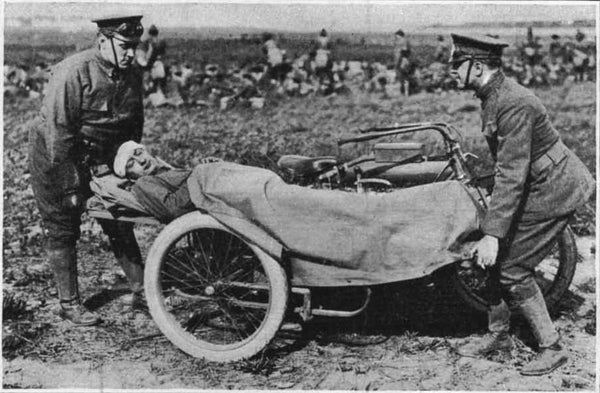
The photographs are of the U.S. Army training maneuvers with the “Sanitary Service,” as the field component of the army’s medical division was labeled. At least one photograph (the “operation”) was taken at maneuvers in Van Cortlandt Park in the Bronx, New York City. The officer in charge of the “operation” is wearing riding spurs; in the background is a blurry image of a horse. The stretcher attached as a sidecar to a motorbike is a good idea using the latest technology for medical transport and clearing casualties from the battlefield. But carrying a stretcher across the mud of the front lines would have been impossible with this setup. My grandfather, however, a medical officer with the Pennsylvania Hospital Unit who embarked for France in July 1917, noted in a letter home that he found a motorbike extremely useful in getting around to attend to his various duties.
-
Our full archive of the war, called Scientific American Chronicles: World War I, has many articles from 1914–1918 on medical care in the First World War. It is available for purchase at www.scientificamerican.com/products/world-war-i/