
This article was published in Scientific American’s former blog network and reflects the views of the author, not necessarily those of Scientific American
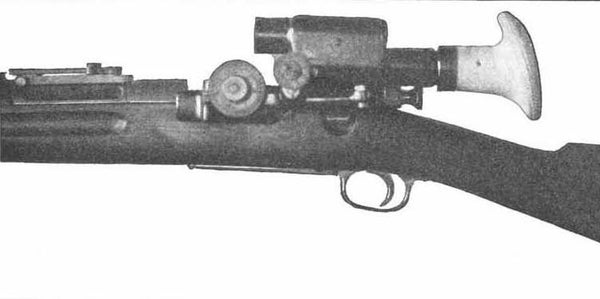
A century ago, this week’s issue of Scientific American had a short article about telescopic sights for sniper rifles: a grim but necessary part of winning battles. The article looks at technical aspects and theoretical use of the device (with a passing jab at the United State’s lackluster preparations for war that some people thought were necessary):
“Whatever the shortcomings of the United States in the way or preparedness, it was one of the first to develop a telescopic sight specially designed for use on a military rifle. Such sights have of course been used for years on target rifles and occasionally in military service, but even those intended for use on sporting rifles were hardly suited to the rough use and exposure incident to active service. In addition to its employment on machine guns for long-range firing, the telescopic sight is intended for the use of trained riflemen, who have the skill to take advantage of its superior optical powers .... We illustrate the sight adopted by the United States Army, mounted on a service rifle [.30-06 Springfield] .... the whole device being readily removable so that it can be carried in a leather pouch for protection when not required. This telescopic sight has a magnifying power of six diameters.”

View approximating that through a telescopic rifle sight. Soldiers in World War One quickly learned to take advantage of any cover when close to enemy troops. Credit: Scientific American, December 2, 1916
On supporting science journalism
If you're enjoying this article, consider supporting our award-winning journalism by subscribing. By purchasing a subscription you are helping to ensure the future of impactful stories about the discoveries and ideas shaping our world today.
One note on the real-world use of the sniper rifle in the trenches of the First World War comes from the Robert Graves autobiography Goodbye to All That (published after the war in 1929). It was a hard-earned review from an officer who had encountered sniper fire in the trenches: “The Germans had the advantage of having many times more telescopic sights than we did, and bullet-proof steel loop-holes. Also a system by which snipers were kept for months in the same sector until they knew all the loopholes and shallow places in our trenches, and the tracks that our ration parties used above-ground by night, and where our traverses occurred and so on, better than most of us did ourselves. British snipers changed their trenches, with their battalions, every week or two, and never had time to study the German trench-geography.”
On of the highest-ranking British casualties from World War One, Brigadier-General John Gough, while in northern France, was hit by a German sniper shooting from perhaps a thousand yards away or more. The round ricocheted off the street surface and hit him in the abdomen; he died two days later. (Johnnie Gough, V.C. by Ian F. W. Beckett, Spellmount Publishers, 1989).
-
Our full archive of the war, called Scientific American Chronicles: World War I, has many articles from 1914–1918 on technological developments in the First World War. It is available for purchase at www.scientificamerican.com/products/world-war-i/