
This article was published in Scientific American’s former blog network and reflects the views of the author, not necessarily those of Scientific American
By the end of March 1917 it was becoming clear that the U.S. would very likely enter the war. Looking at the European experience, it was also clear that even if the industrial base of the U.S. was robust enough to equip its armies, there would be a critical shortage of factory workers. Here’s what our editorial from 100 years ago said:
“Industrial Man Power and the War
“Modern warfare makes terrific demands upon the industries of a nation and through them upon its man power. Now and again there is difficulty with some material supply; but from beginning to end the labor question is continuously acute. Artillery and ammunition, food and clothing, automobiles and aeroplanes and ships, engines and machine tools and tool machines, are but a few of the things consumed in unprecedented quantities. Armed forces and industrial units alike must be kept at fullest strength or disaster follows swiftly.
On supporting science journalism
If you're enjoying this article, consider supporting our award-winning journalism by subscribing. By purchasing a subscription you are helping to ensure the future of impactful stories about the discoveries and ideas shaping our world today.
“Attention has been centered upon the efforts to replace skilled workers who have gone to the front, for this is a spectacular story with news value. Much has been said of the dilution of skilled labor with unskilled, of the employment of a dozen green workers under the supervision of one or two of the former skilled staff. Even more comment has been lavished upon the assignment of women to tasks always heretofore entrusted to men. But when all is said and done, a substitute is a substitute, and the genuine article is to be preferred.

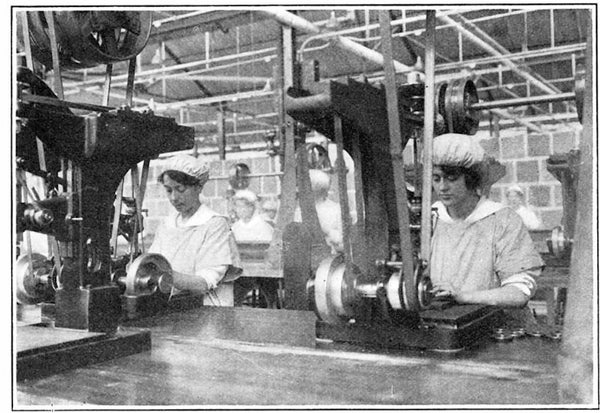
The caption from 1917 is an insight into how the social change in 1917 was viewed: “Modern costumes of female factory workers”. Credit: Scientific American Supplement, March 31, 1917
“If in one respect a woman has an advantage over such a man, in another she is at a disadvantage. No presumption can be asserted against her; on the contrary, there are very many more or less delicate operations at which her small fingers and quick adaptability make it possible for her to develop a degree of speed and accuracy placing her quite beyond the most expert male Competition.
“But in many more places where it would seem that a woman would fit, it turns out that the work demands a physical strength and a measure of endurance which she does not possess. In any event there is the period of schooling; and the one thing which we must at all costs prevent is an initial demoralization of our industries. We must have no mobs of women waylaying these men on their way to work, with rotten eggs and taunts for the ‘slackers.’ It must be plain that between those who are forced or allowed to go out and fight, and those who are allowed or forced to stay home and work, there is no invidious distinction—that all are serving the country in the place where they will count for most.
“The answer, of course, is the formation of a definitely organized Industrial Reserve, membership in which carries all the honors of war, including perhaps a uniform, certainly an insignia. Let every one of our commonwealths forthwith proceed to count noses, to find out just what each individual can do to help his country in this threatened crisis, to organize this body of information as is being done in the Land of Steady Habits.

Women munitions worker in World War One in France. It is possible the photo is staged, given the elaborate dress and the dangers of factory machinery, but possibly not. Credit: Scientific American, March 4, 1916
“Then if the worst comes, each state will be in position at the call to arms to say to each one of its citizens ‘Go’ or ‘Stay,’ as the case may be.”
The editorial was unillustrated, but other articles on women workers provide images for this week’s blog.
The views expressed are those of the author and are not necessarily those of Scientific American.
Our full Archive from 1845 to today, has many articles from 1914 to 1918 on the social changes brought by the First World War. It is available for purchase at www.scientificamerican.com/store/sa-magazine/