
This article was published in Scientific American’s former blog network and reflects the views of the author, not necessarily those of Scientific American
A plant gall, were it to have an animal equivalent, would be truly horrifying.
Galls are plant tumors instigated by parasites. Many creatures manipulate plants into building them, from bacteria to fungi to wasps. The parasite invades the plant, secretes chemicals that induce the plant to construct a house -- or buffet, depending on how you want to look at it -- around it, and then feeds on the tissue of that house. The animal equivalent would be something like a botfly larva that produced a large, protruding tumor on your body in which it ate, slept, and used the toilet.
But galls are not the only plant parasites on the block, and it appears that at least one other plant parasite has found a way to beat them at their game, according to new research from scientists at Rice University published in Current Biology in August (the host plant, as usual, still ends up with the short end of the stick).
On supporting science journalism
If you're enjoying this article, consider supporting our award-winning journalism by subscribing. By purchasing a subscription you are helping to ensure the future of impactful stories about the discoveries and ideas shaping our world today.
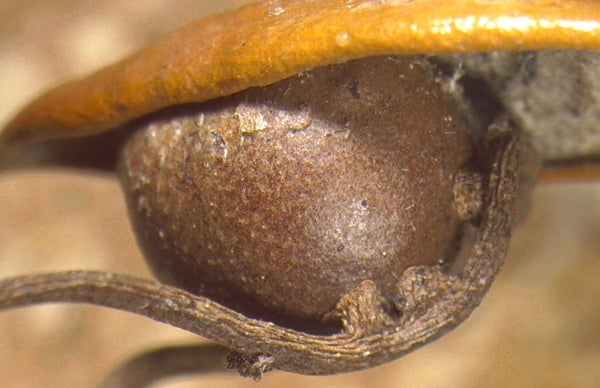
The love vine, Cassytha filiformis, (named for its reputation as an aphrodisiac in the Caribbean) is a parasitic plant that drains resources from its host by tapping that host’s vascular system with peg-like haustoria, not unlike a maple syrup sapper. But the love vine appears to be an equal opportunity parasite. When it encounters a gall formed by wasps on sand live oaks in the scrublands of southern Florida, it taps the gall instead, sucking so many nutrients that in many cases, the wasp dies and mummifies. Turnabout, it seems, is fair play.
Of 2,000 spherical galls formed by the parasitic wasp Belonocnema treatae on the underside of oak leaves collected by the scientists, the love vine had attacked 58, or 2.9%. This was particularly conspicuous as the vine never taps the underside of unparasitized leaves, and the underside of the leaf is the only place such galls form. That tends to rule out chance encounters as a cause, the authors argue.

Credit: Egan et al. 2018
That the vine exacted a toll on its victims seems likely given that 45% of attacked galls contained a mummified wasp, while only 2% of spared galls did. And the love vine seems to love galls, no matter the species. Five other species of gall-forming wasp and one species of gall-forming fly were also attacked by the love vine on oak leaves.
This extraordinary interaction, never before observed in nature, was discovered by a graduate student name Linyi Zhang and a group of undergraduates working with her. When she brought the first samples to her advisor, who had spent many years studying galls, he told her she must be mistaken. She persisted. Relenting, he examined the material under the microscope – only to be startled to discover she was likely right.
The scale of their discovery may ultimately prove much bigger than a bunch of scrub oaks in Florida. More than 4,000 species of flowering plants are parasitic, there are over 13,000 species of gall-forming insects, and they co-exist in just about every habitat on Earth. That such an important interaction was only noticed in 2017 underlines this fact: when it comes to small life, most of our planet is still Terra Incognita.
Reference
Egan, Scott P., Linyi Zhang, Mattheau Comerford, and Glen R. Hood. "Botanical parasitism of an insect by a parasitic plant." Current Biology 28, no. 16 (2018): R863-R864.