
This article was published in Scientific American’s former blog network and reflects the views of the author, not necessarily those of Scientific American
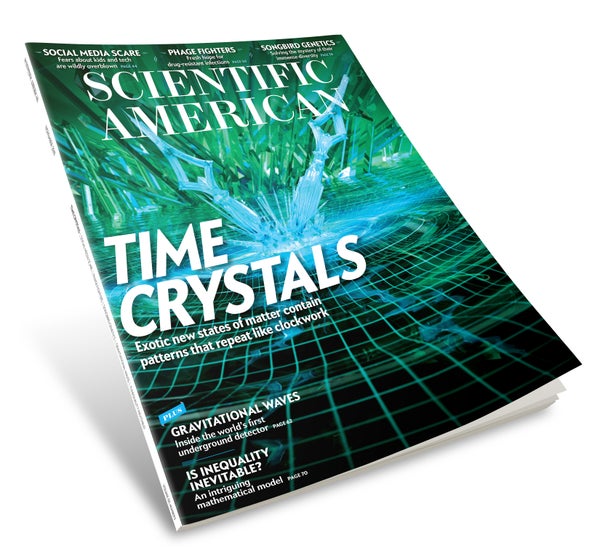
When our creative director, Michael Mrak, sent around the illustration for this month's cover story—a conceptual rendering of so-called time crystals—our features editor, Seth Fletcher, responded, “Cool. Very prog rock.” The artwork certainly seems ready-made for a Pink Floyd album (Roger Waters, if you're reading this, the offer's on the table) or at least one of those velvet blacklight posters. And time crystals are indeed pretty trippy stuff.
Whereas conventional crystals are orderly states of matter whose patterns repeat at regular intervals in space, these more exotic materials have patterns that repeat at regular intervals in time. Theoretical physicist and Nobel laureate Frank Wilczek and his wife, Betsy Devine, coined the term “time crystals” in 2012, and scientists created the first bona fide examples in the lab in 2017. Still a nascent field of research, it is one that could lead to unprecedentedly precise measurements of time and distance, with myriad applications. For more mind-bending details, turn to Wilczek's article, “Crystals in Time.”
On supporting science journalism
If you're enjoying this article, consider supporting our award-winning journalism by subscribing. By purchasing a subscription you are helping to ensure the future of impactful stories about the discoveries and ideas shaping our world today.
Coincidentally, a few of the concepts that appear in Wilczek's story—phase transitions, symmetry breaking and “exquisite” accuracy—also come up, in a more disheartening context, in mathematician Bruce M. Boghosian's piece about the origins of economic inequality, “The Inescapable Casino.” It turns out that they have been “hiding in plain sight,” he writes. Models developed by physicists and mathematicians, which display features of physical systems, reveal that in free-market economies capital naturally trickles up from the poor to the rich, leading to oligarchy. And these models match the extreme concentration of wealth that we see in the world today.
Inequality is also at the heart of journalist Rachel Nuwer's account of biodiversity research in postconflict Colombia (“Conservation after Conflict”). The country, which emerged from decades of civil war in 2016, is home to nearly 63,000 known species and likely many more. Ironically, the years of strife acted to protect this rich natural history, which is now coming under threat as farmers, extractive industries and others move into once dangerous areas. But biologists can now travel more freely as well, and the race is on to tally Colombia's abundant fauna. Yet documentation alone won't save those species. Economic disparity led to war in the first place, so putting biodiversity in service of better livelihoods for Colombians is a critical part of the equation.
Almost everywhere we look, science and society are inextricably intertwined, which is why we must hold researchers to such high standards. Take, for instance, contributing editor Lydia Denworth's description of efforts to improve studies of social media's impact on young people. Science will only ever suggest how to resolve our problems, however—the rest is up to us.
Fortunately, the next generation appears up to the challenge, and we were proud to sponsor the Scientific American Innovator Award at the Google Science Fair, held in August. The 16-year-old winner was Tuan Dolmen of Turkey, who found a way to harness energy from tree vibrations to power digital applications in agriculture. Explore Tuan's project at www.googlesciencefair.com.