
This article was published in Scientific American’s former blog network and reflects the views of the author, not necessarily those of Scientific American
Scientific American’s first issue appeared exactly 170 years ago today. The four-page, black and white broadsheet was published every Thursday morning, with the promise to serve as an advocate of industry and enterprise. Over the decades, many famous thinkers from Albert Einstein to Carl Sagan have filled its pages.
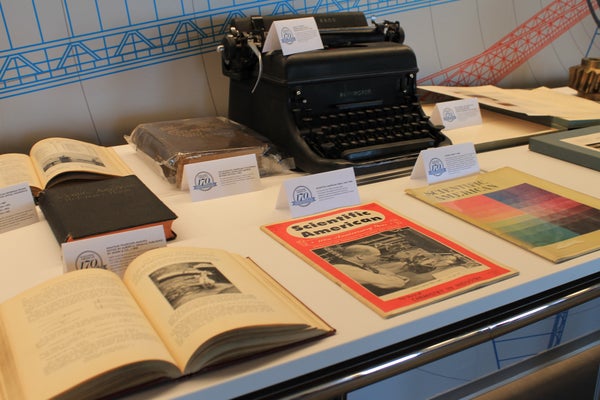
On the evening of August 26, current and former staffers joined other influential science communicators at the publication’s new office in Lower Manhattan to celebrate a long legacy of science communication—Scientific American is the oldest continuously published magazine in the U.S. after all. The night featured an exhibit of memorabilia from company archives and personal holdings, as well as a short, verbal walk through the magazine’s history, delivered by Mariette DiChristina, the current editor-in-chief.

Mariette DiChristina, current editor-in-chief
On supporting science journalism
If you're enjoying this article, consider supporting our award-winning journalism by subscribing. By purchasing a subscription you are helping to ensure the future of impactful stories about the discoveries and ideas shaping our world today.
Items on display included original copies of the publication from the 1800s, dummy issues from its major redesign in 1948, and copper printing plates that were once used to print issues.

Copper printing plates
After 170 years, Scientific American has accumulated a trunk-load of memories. Rufus Porter, an inventor and artist, founded the publication in 1845 (recently, a museum dedicated to him opened in Bridgton, Maine). Since then, the publication has covered many of the major discoveries and innovations in the world of science—ranging from the Wright’s brothers’ first successful airplane to Einstein’s theory of relativity.

Original issues from the 1800s
It defended Marie Curie in 1911 when her application to the French Academy of Sciences was turned down (despite her two Nobel prizes). It was censored by the federal government in 1950, when the U.S. Atomic Energy Commission seized and burned 3,000 copies of the magazine over an article written by Hans Bethe on the hydrogen bomb. For decades, it has unflinchingly presented the evidence in support of hot topics such as climate change and evolution.
More recently, in 2012, the magazine partnered with ScienceDebate.org to ask President Barack Obama and former GOP presidential candidate Mitt Romney to provide answers about 14 science-related policy questions facing America. “Scientific American has been an important part of my organization, which has tried to get presidential candidates to have a debate on science issues,” says Matthew Chapman, co-founder of Science Debate and one of the evening’s many guests (and also, one of Charles Darwin’s great great grandsons).
The magazine has gone through a number of agenda-setting alterations in order to best serve a changing society and readers. “In a time when we hear gloomy stories about the media, it’s great to see a place that has managed to keep reinventing itself to keep it important and relevant,” says John Rennie, Scientific American’s editor-in-chief from 1994-2009. During that era, the magazine went through a significant modernization. “There was a feeling that the magazine was wonderful,” Rennie says, “but it still looked like the same publication that was around in the 50s and 60s. The problem was how to change something that people clearly loved exactly the way it was.”
Scientific American now is part of Springer Nature and more broadly contributes to a global network of science communication. On multiple platforms, the publication continues to document breakthroughs in scientific thought and findings, while also dispelling scientific myths for the general public. “I hope and expect that Scientific American will be here for another 170 years and more,” says DiChristina. “The reason I feel that way is that science itself is inherently an optimistic endeavor and it reflects what it is to be a human—to be curious, to learn, and to discover.”