
This article was published in Scientific American’s former blog network and reflects the views of the author, not necessarily those of Scientific American
Update: 17-year-old Olivia Hallisey of Greenwich, Conn. won the grand prize for her rapid, portable, low-cost Ebola test.
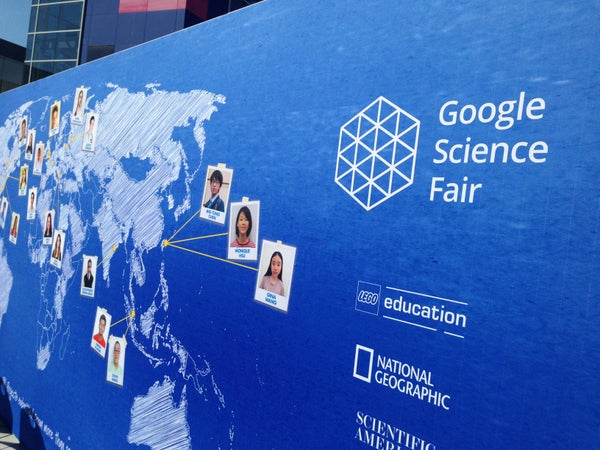
Creativity, ambition and resilience propelled this year’s batch of Google Science Fair finalists to Mountain View, Calif., where they showed off their inventiveness at Google headquarters ahead of tonight’s awards ceremony. The grand prize winner will receive $50,000 in scholarship funding from Google, and a half dozen others will receive awards from fair sponsors Scientific American, Lego, National Geographic and Virgin Galactic.
Watch the live broadcast here tonight at 10:15 pm Eastern Time/7:15 pm Pacific.
On supporting science journalism
If you're enjoying this article, consider supporting our award-winning journalism by subscribing. By purchasing a subscription you are helping to ensure the future of impactful stories about the discoveries and ideas shaping our world today.
Here’s a peek at this year’s batch of young scientific brilliance. For more on all the projects mentioned here, go to the Google Science Fair Web site.
Seashells to the Rescue: While scuba diving in Mexico two years ago, Isabella O’Brien, 13, of Ontario, Canada, saw dead coral for the first time and learned about ocean acidification. She soon came up with a plan to address the problem.
One of the ways that ocean acidification threatens marine life is by reducing levels of calcium carbonate, a building block of seashells. Yet, every year, the seafood industry discards roughly 6 million tons of calcium carbonate in the form of seashells, said O’Brien. If the shells could be recycled, she reasoned, that might help slow acidification. A series of experiments in her basement showed she was onto something. She believes returning pulverized shells to the ocean could help save localized areas, such portions of endangered reefs.
Smartphone blood tests. Tanay Tendon, 18, from Cupertino, Calif. designed a portable diagnostic kit from two smartphones, a magnifying lens, and a toilet paper roll. The pocket microscope, which communicates with software that Tendon designed, can automatically diagnose diseases like chagas, sickle cell anemia, and malaria, reducing the need for trained pathologists and expensive lab equipment.
Tendon was inspired by his grandfather, who worked as a blood pathologist in rural India and died when his mother was very young. “There would be lines of people, villagers that would be waiting for a simple blood biopsy,” he said. “In developed regions, we take that for granted, the easy access we have to blood tests.”
A Robotic Gardener: No one at Eliot Sarrey’s home in Maron, France, has time to tend the family’s vegetable garden. So Sarrey, 14, decided to outsource the labor to a robot that he designed. His Bot2Karot can water plants, hoe, and replant veggies, all with a few swipes and clicks on an iPhone. Read more about his project here: https://www.googlesciencefair.com/en/
Update: Sarrey won the Google Incubator Award, which includes $10,000 and a year of mentorship to further develop his project.
A ‘Trojan horse’ for Alzheimer’s. Krtin Nithiyanandam, 15, from London, designed a molecule that has the potential to sneak past the blood brain barrier to detect the earliest signs of Alzheimer’s disease. The molecule, made up of an antibody and a nanoparticle that emits light, binds with proteins that show up in early stages of Alzheimer’s disease. An MRI scan could then potentially detect the lit-up nanoparticles. “This drug would be able to diagnose the onset of Alzheimer’s disease before symptoms start to show,” said Nithiyanandam, who worked with researchers in a London lab on the more complicated parts of of his project.
Update: Nithiyanandam won the Scientific American Innovator Award, which includes $25,000 and a year of mentorship to further develop his project. In addition, Nithiyanandam's school will receive digital access to the Scientific American archives for 12 months.
Fuel from chicken feathers. Anela Arifi and Ilda Ismaili, teenagers from Bosnia and Herzegovina, discovered that chicken feathers can be used to store and produce fuel. The friends designed a two-reactor system that makes biodiesel from the fat in the feathers and also carbonizes them – turns the feathers into carbon, which can store hydrogen as a fuel source. Inspired by one of their teachers, the two derived creative inspiration from books, TV shows, and even Arifi’s flute. “We don’t have enough pillows to put all the chicken feathers inside, so why not make them into these products?” said Arifi.
Cool vaccines: When Anurudh Ganesan was an infant in Southern India, his grandparents had to carry him 10 miles to the closest vaccine clinic. When they got there, they were told the clinic’s vaccine supply was unusable because of high temperatures and a lack of refrigeration.
“I thought after 15 years, this problem would have been solved, but in fact it hasn’t,” said Ganesan, who now lives in Clarksburg, Maryland. Ganesan designed a wagon that can keep vaccines cool as they’re transported to rural clinics. As the wheels on his wagon turn, they power a mechanical compressor that keeps the vaccines between 2 and 8 degrees Celsius, the range recommended by the World Health Organization.
Update: Ganesan won the LEGO Education Builder Award, which includes a trip to LEGO headquarters in Billund, Denmark and 6 months of mentorship from a LEGO executive.
Quick, cheap cardiac diagnosis: “I come from a family with a really long history of cardiac disease,” says Adriel Sumathipala, 16. His grandfather died of a stroke at 45, and Sumathipala, his brother, sister, and father all have high blood cholesterol.
The Ashburn, VA, teen fashioned a diagnostic test for heart disease from a retrofitted $30 ink jet printer and paper. Instead of ink, the printer deposits enzymes that change color in response to different levels of oxidized LDL and cholesterol, both are markers for heart disease risk. “It’s easy to use and gives patients immediate feedback on how to manage the disease,” he said.
Sumathipala wrote to nearly 100 different professors for help before finding one, at the University of Maryland, who took him under his wing.
IMAGE CREDITS: Anna Kuchment