
This article was published in Scientific American’s former blog network and reflects the views of the author, not necessarily those of Scientific American
I am not enough.
In the era of Brené Brown and Oprah, I'm not supposed to say this, even when it's true. Here. I'll show you.
Take the piece I wrote for The Bark magazine about why dogs hump. You find it informative, but maybe you're wanting a bit more, and bam. There it is. An illustration by Keely Reyes with the bubble, "It's complicated." Perfection.
On supporting science journalism
If you're enjoying this article, consider supporting our award-winning journalism by subscribing. By purchasing a subscription you are helping to ensure the future of impactful stories about the discoveries and ideas shaping our world today.

Keely Reyes in The Bark magazine
Illustrations are like a dollop of ice cream on your brownie, like being tucked in with an extra blanket on a cold night. Illustrations make us whole; they make everything better.
Write about dogs I can do, but help you visualize canine science with something other than my words? Can't help you there (except when I draw informative arrows). Just look at my first (and last) attempt to draw a dog.

That's right. Dog 1 is standing and Dog 2 is sitting, and no, Dog 2 is not a penguin or a frozen turkey with a goat head.
Artists do extraordinary work in the science arena. See for yourself. In its second year running, the Symbiartic crew here at Scientific American asked artists to join the #SciArt tweet storm this past week.
Meet three of my favorite contributors to #SciArt:
Natalya Zahn, @natalya_zahn, Instagram
I found Natalya through her illustrated blog Oscar Ate My Muffin that follows "the charmed life of a Rhodesian Ridgeback with a fondness for discarded or unattended baked goods." It is as good as it sounds.
You can imagine my happiness when Zahn agreed to contribute illustrations to a chapter I co-authored with Alexandra Horowitz for Animal Behaviour for Shelter Veterinarians and Staff. Zahn takes play bows to another level.

And then there are her illustrations for The Bark article '50 Shades of Brown,' which need no further introduction.

Illustration © Natalya Zahn in The Bark magazine
Lili Chin, @lilita_yaya, Facebook, Instagram
Lili Chin partners with experts in training and veterinary behavior and medicine to create educational posters and graphics, many of which are free to download.
Here's one of my favorite posters inspired by this quote: "If you can teach a whale to pee in a cup, you can train your dog without punishment" - Ted Turner (Behaviorist & Exotic Animal Trainer)*

©2012 Lili Chin
Buzz Hoot Roar, @BuzzHootRoar, Facebook
Meet the graphics-driven blog that explains scientific concepts in 300 words or less. It's where I go to learn about the rank stench of asparagus pee or when I can't remember the difference between a turtle and a tortoise or a frog and a toad.
Robin Sutton Anders, Sarah Blackmon, and Eleanor Spicer Rice are the backbone of Buzz Hoot Roar along with resident and guest artists and contributing writers. When it comes to dogs, they've taken on dog humping, brought to life by Jamie Wolfe, and why dogs are better bomb detectors than turkey vultures, written by Cat Warren and illustrated by Christine Fleming.
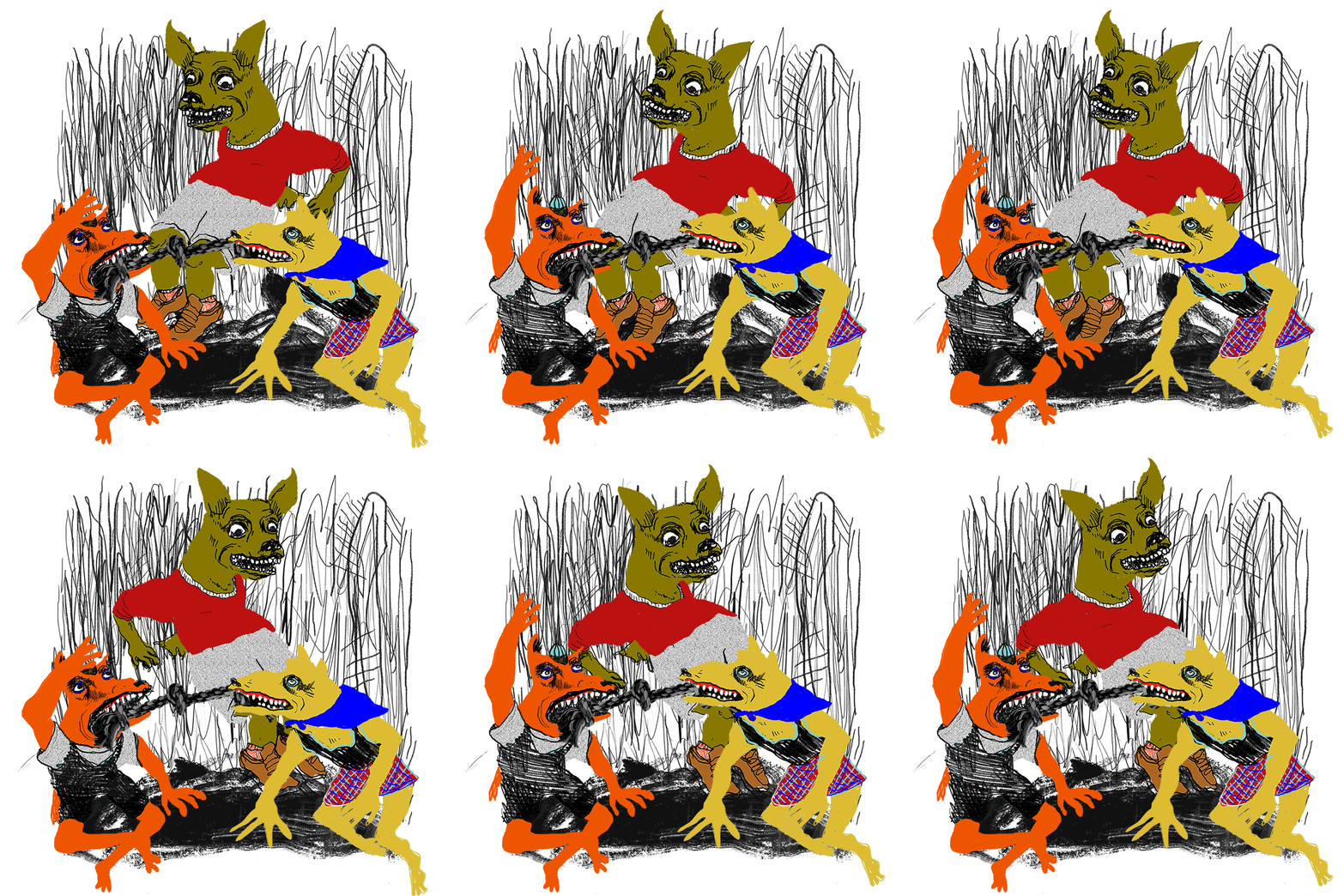
Jamie Wolfe at Buzz Hoot Roar
In conclusion, join me in raising a glass to #SciArt!
* A quick note on punishment: By golly this is not to say that reducing a behavior's frequency or intensity is not part of learning and training. I like this poster because it's filled with great examples of animals who learned to perform a slew of nifty behaviors not because they were forced into it. On the other hand, force and aversive techniques have a longstanding history in dog training despite not being in the best interest of dogs or their human companions. More here from IAABC and Susan Friedman on the growing movement to enhance dog well-being in training.