
This article was published in Scientific American’s former blog network and reflects the views of the author, not necessarily those of Scientific American
Elephant poop matters.
That’s long been understood in Africa, where numerous studies have identified elephants as important dispersers of seeds for a wide variety of plants. Both forest elephants (Loxodonta cyclotis) and bush elephants (L. africana) eat various types of fruits, digest what they can, and then drop the seeds out several hours (and often several kilometers) away from their original location. The seeds then sprout and grow, helping to keep the populations of forest plants healthy. Conversely, research has shown that as elephants disappear, their forests also suffer from the loss of this seed-spreading mechanism. Some tree species face catastrophic declines after poachers eliminate elephants from an ecosystem.
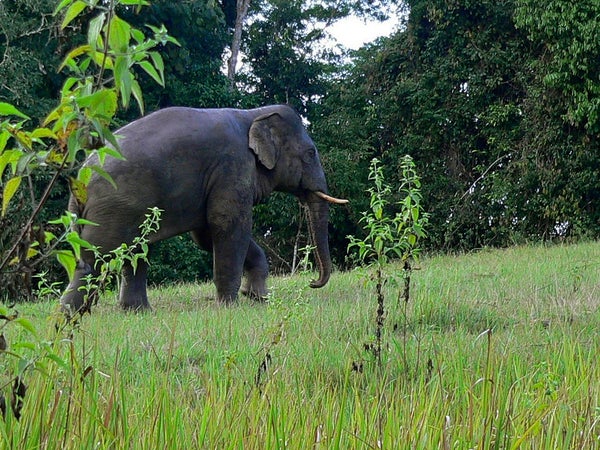
It turns out that African elephants are not alone in this forest health role. New research finds that Asian elephants (Elephas maximus) fulfill much the same function, something that has not been widely studied until now.
On supporting science journalism
If you're enjoying this article, consider supporting our award-winning journalism by subscribing. By purchasing a subscription you are helping to ensure the future of impactful stories about the discoveries and ideas shaping our world today.
Researchers from University of Hohenheim in Germany and other institutions tested this out with a fruit highly associated with elephants: the chulta, or elephant apple (Dillenia indica), an economically important fruiting tree native to Southeast Asia. A trial conducted in Thailand involved feeding the apples to six female elephants, all of which were rescued from previous lives as street beggars. The researchers then followed the elephants, tracked how many hours it took for the apples to be defecated out, and collected the dung and used a sieve to retrieve the apples’ tiny seeds. After that monumental task they planted 1,200 elephant apple seeds, including some control seeds chopped directly out of the fruit, and found that those which had been consumed and partially digested by pachyderms had the highest germination success rates. The more time before the seeds were pooped out, the better they did. The digested seeds also germinated faster than those which had not first gone through an elephant’s gut. This, the authors wrote, is important because once the seeds are on the ground they can be eaten by other predators. The faster the seeds sprout, the more likely they are to survive.
It’s not all about the gut. Feet also matter. According to the researchers’ paper, published in the journal Acta Oecologica, Asian elephants travel several kilometers per day and can have home ranges of up to 1,000 square kilometers. This allows seeds to be dropped far from their parent trees, giving them more opportunities to sprout than if they had been overshadowed or overcrowded by other growth. It also spreads the elephant apples’ range significantly further than if they were just eaten by birds or monkeys.
Elephant apples aren’t completely dependent on elephants for seed dispersal. Another study a few years ago found that monkeys and small rodents can serve the same role, but only after the hard fruits have fallen to the ground and softened. Domesticated cattle also help spread the seeds, but no other species does it as effectively as elephants.
Why does this matter? Elephant apples aren’t rare yet, but they could be, as could other elephant-dependent Asian plants. As the authors note in their paper, “seed-dispersing frugivores are often the first animals to vanish from disturbed forests,” and that’s already happening with Asian elephants, which have lost most of their historic ranges throughout Asia. As they disappear, the plants that depend upon them for seed dispersal may begin to suffer. This, in turn, could affect all of the other species that also rely upon those plants for food or shelter.
It all adds up. As the authors conclude, “stringent protection will not only benefit the pachyderms themselves but also aid in conserving the habitat for a broad range of plant and other animal species, and ultimately sustaining the services such forests provide also for humankind.”
Previously in Extinction Countdown: