
This article was published in Scientific American’s former blog network and reflects the views of the author, not necessarily those of Scientific American
The rarer a species gets, the worse it can be when catastrophe strikes.
That happened early last year when a mysterious disease appeared out of nowhere and within just a few weeks wiped out 90 percent of the world’s Bellinger River snapping turtles (Myuchelys georgesi), a rare species found only in the Australian river for which they are named. The disease caused lesions in the turtles’ eyes, skin and internal organs and invariably led to their deaths. So many turtles died so quickly that conservationists couldn’t even count all of the decomposing bodies.
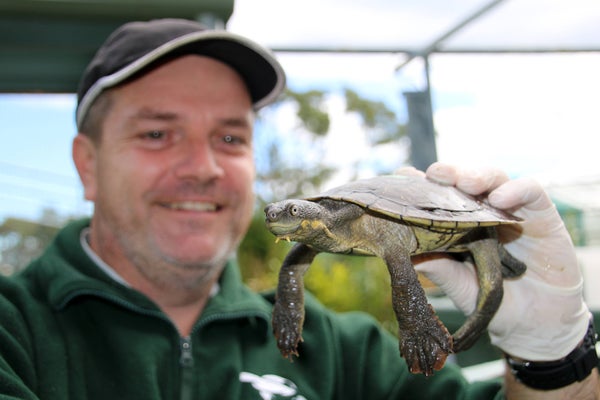
After the virus hit, 17 presumably healthy turtles were brought into captivity and quarantined in the hope of creating a captive-breeding program to save the species from possible extinction. Those hopes have now started to come to pass, as Taronga Zoo in Sydney—which took possession of the animals this past April—reports that 16 of the turtles are out of quarantine and have now started to mate. (The 17th was determined to be a hybrid with another species and therefore not suitable for breeding.)
On supporting science journalism
If you're enjoying this article, consider supporting our award-winning journalism by subscribing. By purchasing a subscription you are helping to ensure the future of impactful stories about the discoveries and ideas shaping our world today.
It’s too early to tell if the females are carrying eggs—we won’t know that for another month—and in fact, maybe we shouldn’t count on them quite yet. “It’s important not to expect eggs this year,” says Western Sydney University zoologist and TurtleSAT manager Ricky Spencer, who has been involved with the rescue efforts and studying the disease. “They are long-lived, so they have time to get that right.”
Time is certainly important. Recent analysis estimated it would take the Bellinger river turtle more than 100 years to recover from last year’s catastrophic die-off. But other recent research suggests the species is many millions of years old, so they have a track record of survival.
Meanwhile, efforts continue to understand the mystery disease and keep the few remaining wild turtles alive. “This species is completely conservation dependent,” Dr. Karrie Rose from the Australian Registry of Wildlife Health said in a prepared statement. “There could be as few as 200 individuals remaining in the wild, so they really need our help.”
For more about the Bellinger River and its threatened turtles, check out this great video by Ricky Spencer: