
This article was published in Scientific American’s former blog network and reflects the views of the author, not necessarily those of Scientific American
Last year researchers working in the French territory of New Caledonia made the sad declaration that two of the Pacific archipelago’s native plant species had probably gone extinct.
Then they got a box in the mail.
“I was just amazed,” says Jérôme Munzinger with Institut de Recherche pour le Développement (IRD) in Marseille. “This was one of the strongest botanical feelings of my life.”
On supporting science journalism
If you're enjoying this article, consider supporting our award-winning journalism by subscribing. By purchasing a subscription you are helping to ensure the future of impactful stories about the discoveries and ideas shaping our world today.
The box, from amateur botanist Rosa Scopetra, contained two things: a USB drive loaded with photos and samples of two flowering plants. One sample was a threatened species called Eugenia plurinervia which Munzinger and his colleagues had just described for the first time last year.
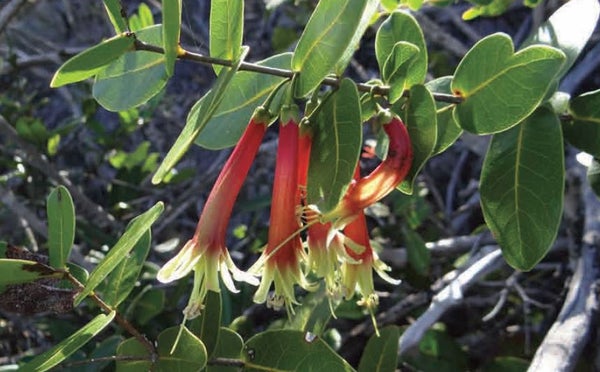
The other sample was more unexpected. It was obviously Pycnandra longiflora, one of the species they had just declared as probably being extinct. It was the first time a scientist had seen the flower since it was first described back in the 1860s.
“Rosa had contacted me, but just said she wanted to show me something,” Munzinger says. “She didn't say what it was.” What he received was, he says, “just a wonderful plant.” In a paper published this month in journal Biotaxa, Munzinger and his colleague, Ulf Swenson of the Swedish Museum of Natural History, describe the newly rediscovered species as having “spectacular bicolored flowers with red tubes and yellow corolla lobe” and wrote that it “has the largest and the most beautiful flowers in the entire genus.”
Despite its size—P. longiflora shrubs average 1.7 meters in height—it’s easy to understand why the researchers had trouble locating it in their previous searches. Upon investigating Scoptera’s discovery, they found that the plants grow on just two adjacent sites on the northwest coast of Grande Terre island, about 600 meters from a main road. The 176 individual plants they found there occupied just 0.6 square kilometers of territory. The authors wrote that the two sites “easily could be ruined by a single fire, forest clearance, or an enlargement of the truck access” to a nearby mining concession.
This last point is probably the most important. The plants grow on what is known as ultramafic substrate, which contains valuable metals. “Ultramafic substrates are of high economic value in New Caledonia for nickel and cobalt mining,” Munzinger says. He points out that no other vegetation species on ultramafic substrates in New Caledonia’s North Province currently have protection.
Because of its limited range and population, and very real potential threats, the researchers have called for the species, which they consider critically endangered, to be protected.
That doesn’t seem very likely.
“We hope this kind of discovery will help, but we have already described many new species restricted to one mountain or one valley that are still without any protection,” Munzinger says. “There are so many ‘micro’ endemic species on this archipelago that conservation is a huge challenge.”
That said, the researchers plan to look for additional populations of the rediscovered P. longiflora, and Munzinger says other researchers are trying to organize special field trips to relocate additional rare species, including others that are also only known from descriptions first made 150 years ago.
Could those searches turn up the other species that they declared to be extinct, a related flower from nearby Art Island called P. micrantha? “I wish so,” Munzinger says, “but we visited Art Island some years ago and didn't find it.” Since then, he says, the likelihood of rediscovering it has fallen even more. “Unfortunately a huge fire damaged an important part of the island this year, so chances of finding this plant remain very small.”
He adds, though, that he was thinking the same thing about P. longiflora just a few months ago. With that rediscovery under their belts, the researchers seem energized to learn what they will uncover next.
Any additional mysterious boxes are welcome.
Previously in Extinction Countdown: