
This article was published in Scientific American’s former blog network and reflects the views of the author, not necessarily those of Scientific American
Sometimes science happens when you stumble across new idea. Other times you literally trip over it.
That’s how a team of researchers working on Luzon Island in the Philippines recently discovered one of the world’s most unusual plants. A field assistant working with biologists from the University of the Philippines literally stumbled over a pile of forest litter and in the process uncovered a decaying flower that was later revealed as an entire new species.
As described earlier this month in the journal PhytoKeys, the new species is a parasitic flower from the Rafflesia genus, a group of plants that includes the world’s largest flowers. One of these species, R. arnoldii, which grows on Sumatra and Borneo, reaches sizes of more than 1.5 meters in diameter and emits am odor not unlike that of rotting flesh. That ripe aroma, an adaptation designed to attract pollinators, has led to it being nicknamed the “corpse flower.” (A similar, more famous plant called the titan arum, Amorphophallus titanum, shares that particular sobriquet.)
On supporting science journalism
If you're enjoying this article, consider supporting our award-winning journalism by subscribing. By purchasing a subscription you are helping to ensure the future of impactful stories about the discoveries and ideas shaping our world today.
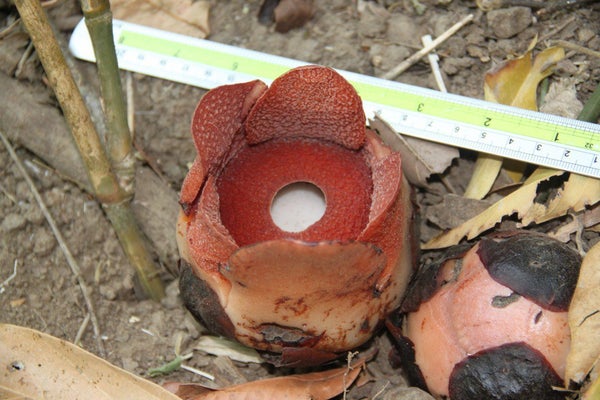
The new species, R. consueloae, stands out from its larger relatives in two distinct ways. For one thing, its flowers only reach about 10 centimeters, making it what researchers call “the smallest among giants.”
For another, it smells not like death but like coconut meat.
All Rafflesia species look kind of like the carnivorous Audrey II from “Little Shop of Horrors,” but despite their parasitic nature they don't eat meat. Instead, like vegetarian vampires, they attach to the roots and stems of other plants and suck out the nutrients and water they need from their hosts. Rafflesia lack leaves, stems or roots of their own, making them completely dependent upon their parasitic lifestyles.

Edwino S. Fernando, University of the Philippines
In the case of R. consueloae, the discovery of the “smallest giant” may yet lead to the discovery of other new species. The researchers observed it attaching to an as-yet-unknown species of a grape vine from the genus Tetrastigma. The larger R. arnoldii similarly parasitizes off another Tetrastigma species. Exactly how the tiny parasite taps into its host remains unknown, as the grape vines have particularly tough skins.
We also, presumably need to discover what pollinators are attracted to the smell of coconut.
Another big mystery is how this new species propagate itself. The researchers observed two species of rodents and some other wildlife feeding upon R. consueloae fruits, which may be how their seeds are distributed, but their research at this point is inclusive.
Learning more about this new species could a time-sensitive proposition. The researchers warn that R. consueloae should be considered critically endangered, as they only discovered two small populations with a total range of less than 100 square kilometers. The habitats themselves are under a small amount of threat from local hunting and forest fires, so further monitoring may be required to help keep this tiny corpse flower from disappearing in the future.