
This article was published in Scientific American’s former blog network and reflects the views of the author, not necessarily those of Scientific American
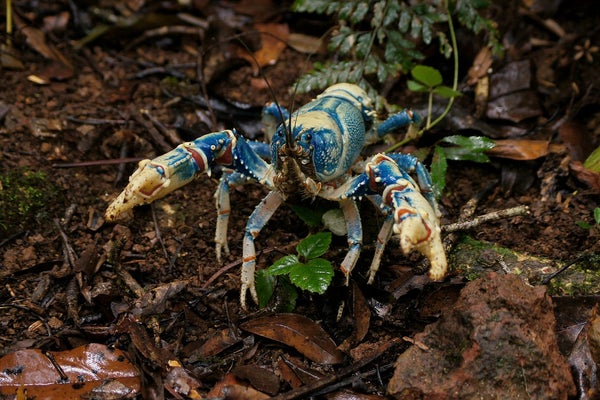
Australia’s gorgeous and colorful spiny crayfish are in the middle of an extinction crisis. Of the 52 crayfish species from the genus Euastacus, at least 34 are currently endangered or critically endangered due to habitat fragmentation and climate change.
If these crayfish go extinct, they won’t be alone. According to research published last month in
Proceedings of the Royal Society B, the disappearance of many spiny crayfish species could create a cascading effect, causing dozens of other species to blink out of existence.
On supporting science journalism
If you're enjoying this article, consider supporting our award-winning journalism by subscribing. By purchasing a subscription you are helping to ensure the future of impactful stories about the discoveries and ideas shaping our world today.
No, they’re not the fish or birds or other species that eat the crustaceans. These other extinctions would actually come from two groups of microscopic tapeworms that have evolved over the past 80 to 100 million years to form perfectly symbiotic relationships with their host crayfish. The tapeworms lay their eggs on the crayfish and then live on their hosts’ surfaces or in their gills, where they feed on even smaller animals that can be found in the surrounding waters or on parasites that could harm the crayfish.
Most of these tapeworms, from the similarly named genera Temnohaswellia and Temnosewellia, are extremely specialized. According to DNA tests conducted for this new study, many have only a single host crayfish species. That, despite the fact that they’ve been around for millennia, makes them especially vulnerable to extinction themselves as their hosts disappear, a process called co-extinction. According to the paper, 62 percent of Temnosewellia species and 46 percent of Temnohaswellia species risk disappearing along with their hosts.
The effect isn’t universal. The researchers examined 37 of Australia’s 52 spiny crayfish species and their tapeworms. They found that some of the worms enjoyed symbiotic relationships with more than one host crayfish species; those, they wrote, are the most likely to survive. On the other hand, 54 percent of the tapeworms in the southern half of the crayfishes’ range each had only a single host species. That left them in a more precarious position.
Obviously no one is going to read this study and take up arms to “Save the Tapeworms!” Still, this presents an interesting look at an otherwise invisible portion of the natural world and the long-standing processes and co-dependencies that exist beneath the surface. Beyond that, it is also one more sign that the world is a system and that no species lives in a vacuum, not even a microscopic tapeworm.
Previously in Extinction Countdown:
Conservation Group Seeks Protection for Endangered Crayfish, Gets Newly Discovered Species as a Bonus
British Crayfish Now Officially Endangered, Thanks to Killer Fungus
Sleeping Sickness Parasite Susceptible to Extinction Because It Hasn't Had Sex in 10,000 Years
The Cuckoo Reason Why These Bumblebees May Go Extinct