
This article was published in Scientific American’s former blog network and reflects the views of the author, not necessarily those of Scientific American
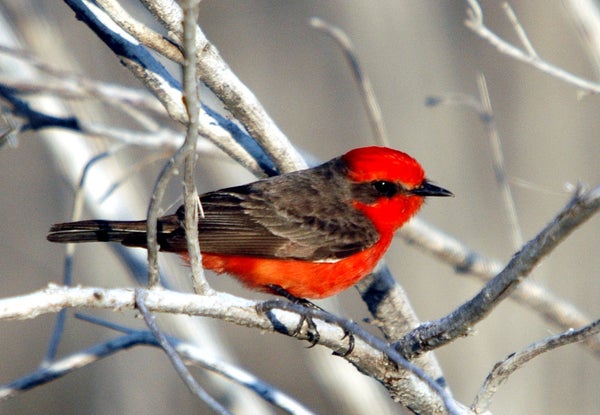
Meet the San Cristóbal vermilion flycatcher (Pyrocephalus dubius), the newest bird species to be discovered in the Galapagos Islands.
No, wait. You can’t meet the San Cristóbal vermilion flycatcher. It’s extinct.
The news of this San Cristóbal vermilion flycatcher’s extinction isn’t exactly a shock. The birds, which only lived on the easternmost island of the Galapagos, haven’t been seen since 1987. Numerous searches since then have failed to turn up any evidence that they still exist.
On supporting science journalism
If you're enjoying this article, consider supporting our award-winning journalism by subscribing. By purchasing a subscription you are helping to ensure the future of impactful stories about the discoveries and ideas shaping our world today.
But a search of museum samples on a molecular level has revealed something else that no one had seen. According to research published last month in the journal
Molecular Phylogenetics and Evolution, the San Cristóbal vermilion flycatcher is—or was—genetically and morphologically distinct from its nearest relatives. Previously considered to be a subspecies, the birds of San Cristóbal have now been elevated to species status.
This, according to the paper, makes them the first endemic bird species—not just a subspecies—to go extinct in the Galapagos.
The exact cause of this extinction is unknown, but other vermilion flycatcher subspecies currently
face threats from invasive rats, which eat the birds’ eggs, and a parasitic fly called Philornis downsi, which attacks and kills any chicks that manage to hatch, according to the Durrell Wildlife Conservation Trust.
Could the same fate soon befall a related species? The paper also elevates another Galapagos flycatcher subspecies to full species status, now known as P. nanus. The authors note that several populations of these birds have already disappeared or “are in serious decline,” with some islands now hosting as few as 20 flycatchers. They call for immediate conservation measures to protect the newly recognized species’ genetic diversity before it disappears.
That’s not all. The paper says there’s some evidence that P. nanus may also be multiple species. They’re calling for additional studies to determine if even more species are hidden in plain sight before they all go the way of the San Cristóbal vermilion flycatcher.
Previously in Extinction Countdown:
RIP, Lonesome George, the Last-of-His-Kind Galapagos Tortoise
Once Extinct in the Wild, Galapagos Giant Tortoises Return to Pinzon Island
Blue-Footed Boobies Have Stopped Breeding, But Why?