
This article was published in Scientific American’s former blog network and reflects the views of the author, not necessarily those of Scientific American
Single males are the George Costanzas of the animal kingdom.
They’re outsiders. Nobody pays much attention to them. Conservationists rarely bother to watch them or learn where they live. They’re effectively invisible to the world, much like our favorite obnoxious bumbler on the classic network sitcom, Seinfeld.
Maybe that should change. According to a paper published this week in Evolutionary Applications, these un-mated males could actually be some of the most important individuals in the populations of certain endangered species.
On supporting science journalism
If you're enjoying this article, consider supporting our award-winning journalism by subscribing. By purchasing a subscription you are helping to ensure the future of impactful stories about the discoveries and ideas shaping our world today.
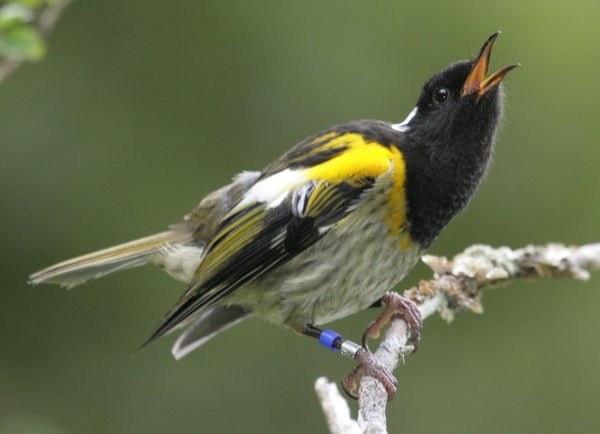
Take the hihi (Notiomystis cincta) for example. These small, colorful, nectar-eating endangered birds, also known as stitchbirds, once lived throughout the islands of New Zealand. That era ended in the 19th century when the species nearly went extinct, probably due to introduced predators and diseases. Until a few decades ago the birds remained in only one location, Little Barrier Island, 80 kilometers off the coast of New Zealand’s North Island.
Today, thanks to an ongoing translocation program, hihi now also live in small populations on a few additional nearby isles. One of these, tiny Tiritiri Matangi Island, is home to fewer than 150 birds, which live in constructed nesting boxes and receive daily, dutiful attention from conservationists.
Almost all of the adult hihi birds on Tiritiri Matangi are in long-term mated couplings, although there are a few Costanzas in the mix who skip relationships for independence. Scientists call these males “vagrants” or “floaters.” Like the character who often pretended to be an architect, and once a marine biologist, they lack permanent companions (or even nests of their own) but they still manage to sneak in and coerce females into mating—quite a feat because male hihis can be quite territorial.
This behavior, according to researchers from the Zoological Society of London (ZSL) and other institutions, plays several important roles in such a small population. It increases the number of breeding birds, improves genetic diversity and decreases inbreeding.
The authors argue that “floaters” probably deserve more conservation attention, especially in small populations. “Despite being difficult to study, as they have no fixed abode, we should pay more attention to these bachelor males as they can potentially have a big effect on genetic diversity, and therefore the survival of species with very few individuals remaining,” the study’s lead author, ZSL research Patricia Brekke, said in a prepared release. “Not taking floating individuals into account can undermine our conservation efforts.”
Understanding the role of floaters could definitely help the work to preserve this unique species. Hihi are the only members of their genus and family as well as the only bird species ever observed to mate face to face. Despite several decades of preservation, the total population still hovers at about 2,000 birds. That means every breeder, and every George Costanza, matters—if they apply themselves.
Photo © Eric Wilson, courtesy of the Zoological Society of London