
This article was published in Scientific American’s former blog network and reflects the views of the author, not necessarily those of Scientific American
Around the world, animals living and breeding in captivity tend to be managed through a technique called a stud book. These decades-deep records keep track of which males bred with which females and which offspring resulted from their unions. Stud books help zoos and other conservation organizations to make sure that the animals in their care don’t interbreed and end up with debilitating genetic defects and ensure that their progeny remain as healthy as possible through the years.
New Zealand is about to take the stud book concept to a whole new level and apply it genetically to a species that lives in the wild.
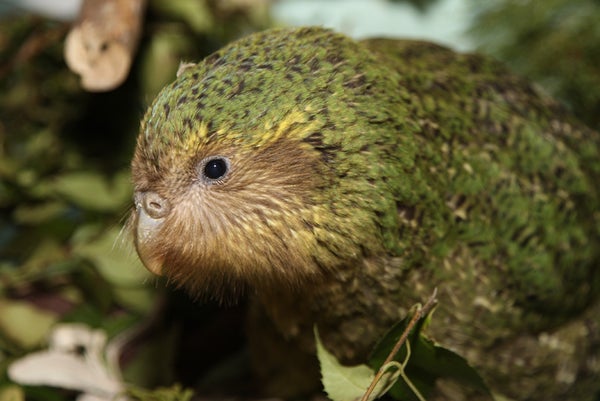
Well, kind of. The world’s last 125 kakapo parrots (Strigops habroptila) all live in a semi-wild state on a series of protected islands. The breeding of these massive, flightless birds—which only occurs about once every three years—is already carefully managed, but that’s not necessarily enough.
On supporting science journalism
If you're enjoying this article, consider supporting our award-winning journalism by subscribing. By purchasing a subscription you are helping to ensure the future of impactful stories about the discoveries and ideas shaping our world today.
Heck, when you’ve only got 125 birds left in a species and they’re all descended from just a few individuals that narrowly escaped extinction a few decades ago, you need to take every effort to make sure that every possible mating produces the best possible chicks.
Enter genetics. A female kakapo names Jane recently became the first member of her species to have her genome sequenced. She won’t be the last. A new program hopes to sequence the genomes of all 124 other kakapo, an effort that will cost $100,000. They’re currently raising $45,000 to sequence a batch of 40 older birds through Experiment, the scientific research crowdfunding platform. The remainder will be funded by the Genetic Rescue Foundation, which is accepting $400 donations to sequence the genomes of individual kakapo, including Sirocco, the species’ world-famous spokesbird.
If successful, this will be the first time that every single member of a species has had its genome sequenced.
The tests will be performed by New Zealand Genomics Ltd. at the University of Otago. The first batch of 40 could be completed as early as this March.
Kakapo Recovery—which manages all of the efforts to protect and preserve the species—says the genetic research will enable several critical pieces of information. First, they’ll have a better understanding of which birds are related to each other, even better than the current family tree that tracks what the organization calls “one big extended family.”
Second, the genetic tests will allow them to identify functional kakapo genes, such as anything that might affect fertility or susceptibility to disease.
Finally, the tests could help to identify any individuals carrying rare alleles. These genetic variants could be things that need to be preserved in the genetic line or even conceivably genes that need to be bred out in order to maintain the species’ health.
All of this comes just before the 2016 kakapo breeding season, which could be the best in years. Kakapo only breed in seasons when there’s a good supply of fruit of the rimu tree (Dacrydium cupressinum). This is a good year for rimu, and as a result the Kakapo Recovery Foundation reports that at least 15 female kakapo have already mated and one has laid three fertile eggs.
Any chicks that result from this year’s breeding season won’t start reproducing themselves for at least six years, but by then an enhanced studbook bolstered by genetic information will definitely be a reality. And it will no doubt help conservation efforts for decades to come: a kakapo can live an estimated 95 years. That’s a lot of potential future chicks that these genomic tests will help as this species continues its climb forward from extinction.
Previously in Extinction Countdown:
Kakapo Baby Boom in New Zealand: First New Chicks in 3 Years [Video]
Dung from Critically Endangered Kakapo Parrots Could Save Endangered Plant
Accidental Kakapo Death Lowers Population of Rare, Flightless Parrots to 127 Birds