
This article was published in Scientific American’s former blog network and reflects the views of the author, not necessarily those of Scientific American
A tiny fish just got a big—and slightly overdue—victory.
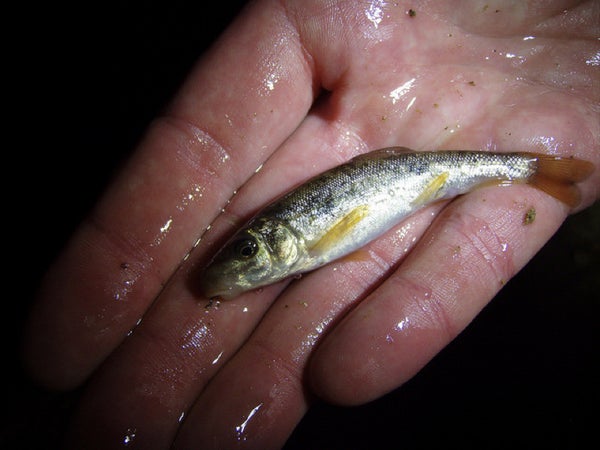
The U.S. Fish and Wildlife Service (FWS) announced this week that the Modoc sucker (Catostomus microps), a rare fish from California and Oregon, has recovered and will now leave the protection of the Endangered Species Act (ESA).
This is actually the second attempt to delist the fish. It almost left the ESA earlier this year but FWS forgot to post an announcement in local newspapers, as required by law, forcing them to delay their plans.
On supporting science journalism
If you're enjoying this article, consider supporting our award-winning journalism by subscribing. By purchasing a subscription you are helping to ensure the future of impactful stories about the discoveries and ideas shaping our world today.
Now that the full legal requirements have been met, the sucker will become the second endangered fish to recover in the U.S., following the Oregon chubb (Oregonichthys crameri), another small fish that left the ESA earlier this year. The chubb’s population boomed from fewer than 1,000 when it was protected in 1993 to more than 140,000 fish in 80 locations today.
The Modoc sucker hasn’t enjoyed quite the same level of success, but it is doing much better than it was when it was first protected in 1985. Back then it was restricted to just seven streams totaling about 21 kilometers. Today it swims in 12 streams with a range of more than 70 kilometers. The population, meanwhile, has doubled from 1,300 to more than 2,600.
Protecting the Modoc sucker required efforts on two fronts. First, both the California and Oregon fish and wildlife departments had to stop stocking the sucker’s habitat with non-native brown trout (Salmo trutta) for recreational fishermen. The larger European fish preyed upon the suckers and took a toll on their populations. The invasive fish still exist in the sucker’s streams, but they are no longer thought to pose a major risk since their populations are no longer being artificially supplemented.
The second challenge involved protecting the sucker’s rivers themselves. Livestock used to graze at the banks of the rivers and the loss of native vegetation resulted in erosion that filled in the deep pools the suckers use to stay cool during hot summer months. The degradation also connected previously separate streams and allowed a related species, the Sacramento sucker (C. occidentalis) to move into the area and hybridize with the Modoc suckers. Livestock fences, replanting programs and back-breaking work to remove debris and place boulders helped to restore the habitat, efforts that were made possible by collaboration between FWS, state agencies and local landowners.
With those threats out of the way and populations stable, this appears to finally by the right time to delist the Modoc sucker, a change that will become official in 30 days. FWS will continue to monitor the fish’s population for five years in order to make sure that populations remain healthy following delisting. That will remain important, as new threats could emerge. According to the Center for Biological Diversity, climate change and drought could pose future risks for these tiny fish. For now, though, they’re swimming just fine.
Photo courtesy of U.S. Fish and Wildlife Service