
This article was published in Scientific American’s former blog network and reflects the views of the author, not necessarily those of Scientific American
A rare South African flower first described by a pioneering feminist scientist in 1862 but unseen since then has finally been rediscovered.
Mary Elizabeth Barber, South Africa’s first woman ornithologist and botanist and a correspondent of Charles Darwin, described dozens of bird, plant and insect species over the course of her lifetime. More than a century after her death in 1899, several of those species still bear her name.
But one of the species she discovered, a plant called Mrs. Barber’s beauty (Lotononis harveyi), has remained a bit of a mystery. Although the samples she collected can still be examined in museums, the living flowers eluded rediscovery for decades.
On supporting science journalism
If you're enjoying this article, consider supporting our award-winning journalism by subscribing. By purchasing a subscription you are helping to ensure the future of impactful stories about the discoveries and ideas shaping our world today.
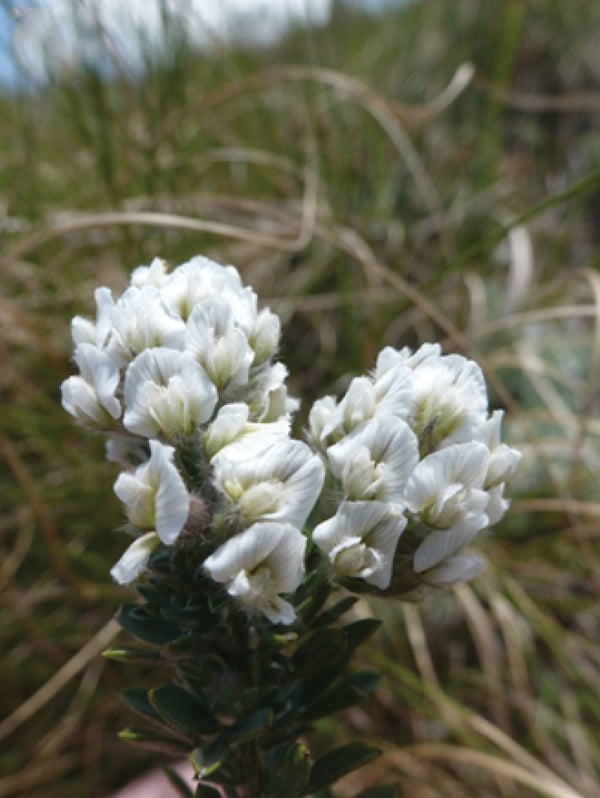
Until now. The beautiful plant has finally been found once again and photographed for the very first time.
Vincent Ralph Clark of Rhodes University in South Africa actually first rediscovered Lotononis harveyi in 2009—147 years after Barber’s description was first published—while conducting field work in the Great Winterberg mountain range for his Ph.D. At the time, though, he didn’t realize exactly what he had seen. A sample he collected that year was reexamined in 2014 by University of Johannesburg botany professor Ben-Erik Van Wyk, who suggested the white flower with densely hairy petals could be the lost species.
With that encouraging revelation, Clark returned to the Winterbergs later that year and extended his search. He not only found the plant he saw in 2009 but also located several others. The confirmed rediscovery was finally published this month in the journal PhytoKeys..
What Clark also confirmed is that Mrs. Barber’s beauty probably eluded rediscovery not just because of its remote location but also its slow growth rate and rarity. He found just six specimens, two of which had damaged stems, and no evidence of recruitment of the next generation of plants. This, along with potential threats from fire and livestock, led him to suggest that the flower should be considered critically endangered.
There could be more than just those six plants out there, of course, as the steep mountain does a pretty good job of keeping its secrets. Additional expeditions would be required to find them, as well as to learn more about the elusive Mrs. Barber’s beauty. The paper notes that we know “virtually nothing about its biology.” That means that although this rare flower has now finally been found once again, we don’t know what it would take to preserve it or its habitat.
But at least it’s been found. For the elusive Mrs. Barber’s beauty, that’s the first step toward making sure it’s around for at least another 147 years.