
This article was published in Scientific American’s former blog network and reflects the views of the author, not necessarily those of Scientific American
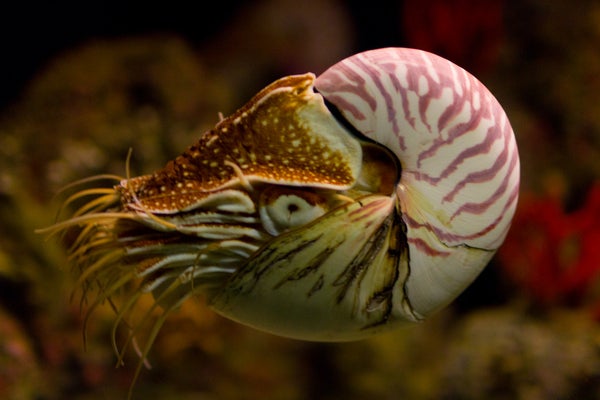
The world’s most mathematically perfect marine species moved a little bit closer to protection last week when the National Oceanic and Atmospheric Administration agreed to consider listing the chambered nautilus (Nautilus pompilius) under the Endangered Species Act.
The move comes after several years of hard work on the part of conservationists and federal agencies to understand the massive scope of the nautilus trade and how it impacts wild populations. According to that research, nearly 1.7 million of these mollusk shells—the natural embodiment of the Fibonacci spiral—have been imported into the U.S. alone over the past 16 years, where they’re sold for anywhere between $15 and $200. The trade in nautilus shells is so bad that it has all-but depleted many populations of these ancient animals.
Further imports as well as interstate trade would become illegal if the species does gain Endangered Species Act protection.
On supporting science journalism
If you're enjoying this article, consider supporting our award-winning journalism by subscribing. By purchasing a subscription you are helping to ensure the future of impactful stories about the discoveries and ideas shaping our world today.
Of course, that’s a long process that could take several years. Right now NOAA is conducting a formal status review for chambered nautiluses, which will collect all available information on the species. Data and public comments will be collected through October 25.
“If, after reviewing the best available scientific and commercial information and after taking into account conservation efforts to protect the species, we determine that listing the species under the ESA is warranted, we will publish a proposed rule proposing to list the species as threatened or endangered and solicit public comments,” says Kate Brogan, public affairs officer with NOAA’s National Marine Fisheries Service.
International action could actually come much faster than that. The U.S., Fiji, India and the island national of Palau have teamed up to request that nautiluses also be protected under the Convention on International Trade in Endangered Species (CITES). That proposal, along with many others, will be discussed next month at CoP17, the meeting of the treaty’s signatories. If passed, nautiluses would be added to CITES Appendix II, which would regulate but not outright ban trade on the international market.
The CITES proposal would actually go further than the ESA proposal as it would cover all six nautilus species, not just the chambered nautilus. Abel Valdivia, a marine scientist with the Center for Biological Diversity, the conservation organization that petitioned for nautilus protection, says the ESA proposal will still help dramatically as it would protect the most heavily traded species. “Most of the international shell trade of nautilus is of chambered nautilus because it is the most common species,” he says. “Over 90% of complete shells imported to the U.S. in the past 16 years are classified as chambered nautilus.”
Nautilus shells are admittedly one of nature’s great wonders and it’s easy to see why people would want to own and admire them. Hopefully these two important steps towards protecting these ancient creatures will allow us to continue enjoying them for many years to come.