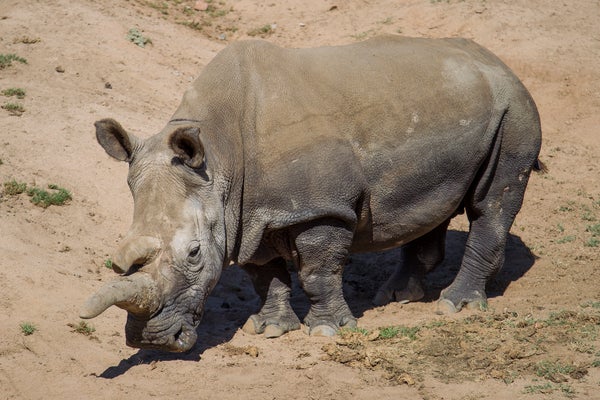
Northern White Rhino Dies, Leaving Just Three on the Planet

This weekend’s death of 41-year-old Nola in San Diego pushes the species even closer to extinction

Join Our Community of Science Lovers!

This article was published in Scientific American’s former blog network and reflects the views of the author, not necessarily those of Scientific American


The extinction of the northern white rhino (Ceratotherium simum cottoni) draws ever closer. Nola, a 41-year-old female that has lived at the San Diego Zoo Safari Park since 1989, was euthanized this morning after she stopped eating and her activity levels dropped. Nola had undergone surgery on Nov. 13 to drain an infected abscess within her pelvic region. The surgery was successful, but the zoo reports that Nola’s condition worsened over the past 24 hours.

With Nola’s death, there are now only three northern white rhinos left on the planet, all of which live at Ol Pejeta Conservancy in Kenya.

The two remaining female rhinos are incapable of natural reproduction. The last surviving male, Sudan, has a very low sperm count but the conservancy still has hopes for in vitro fertilization.


On supporting science journalism

If you're enjoying this article, consider supporting our award-winning journalism by subscribing. By purchasing a subscription you are helping to ensure the future of impactful stories about the discoveries and ideas shaping our world today.


San Diego Zoo recently set aside $2 million as part of an effort to keep the species from going extinct by implanting northern white rhino embryos into surrogates from the related southern white rhino subspecies (C. s. simum). That plan may still come to fruition, as the zoo has a collection of suitable genetic material in its Frozen Zoo.

Northern white rhinos went extinct in the wild after years of extensive poaching for their valuable horns, which are used in traditional Asian medicine. The last wild northern white rhinos were killed in the Democratic Republic of the Congo in 2006.

Nola is being eulogized today on Twitter under the hashtag #Nola4Ever.

Photo: San Diego Zoo Global

John R. Platt is the editor of The Revelator. An award-winning environmental journalist, his work has appeared in Scientific American, Audubon, Motherboard, and numerous other magazines and publications. His "Extinction Countdown" column has run continuously since 2004 and has covered news and science related to more than 1,000 endangered species. John lives on the outskirts of Portland, Ore., where he finds himself surrounded by animals and cartoonists.

More by John R. Platt

Subscribe to Support Independent Journalism

Great science journalism requires human expertise, time, effort and creativity. And it costs money. That’s why I and the journalists here at Scientific American hope you’ll join our community.

When you subscribe, you are supporting staff and freelance journalists who are passionate about telling science stories that are true, important and compelling. Our editors and reporters are often experts in their fields, which means they understand the nuances of big discoveries and can untangle the breakthroughs from the hype. With a subscription, you are also supporting rigorous fact-checking to ensure the words we publish are precise and accurate. And you’re supporting original illustrations, graphics and photos that bring you closer to an advanced laboratory, an ice sheet in Antarctica or a space mission in orbit. You’re helping us craft other types of high-quality journalism as well: Our newsletters are carefully written, edited and curated by staffers you have or will come to know and love. Our Science Quickly podcast is based on original reporting, collaboration with editors and scientists and exacting production.

Subscriptions keep this engine running so we can continue to deliver thoughtful, rigorous and independent science journalism to you. In an era of viral misinformation, this work is crucial. If you value what we do, I hope you’ll consider joining us as a subscriber

Thank you,

Jeanna Bryner, Editor in Chief, Scientific American

Subscribe