
This article was published in Scientific American’s former blog network and reflects the views of the author, not necessarily those of Scientific American
Like a lot of people, I make sure to get a flu shot every year. That’s because the viruses that cause influenza mutate all the time, creating new strains that require new treatments.
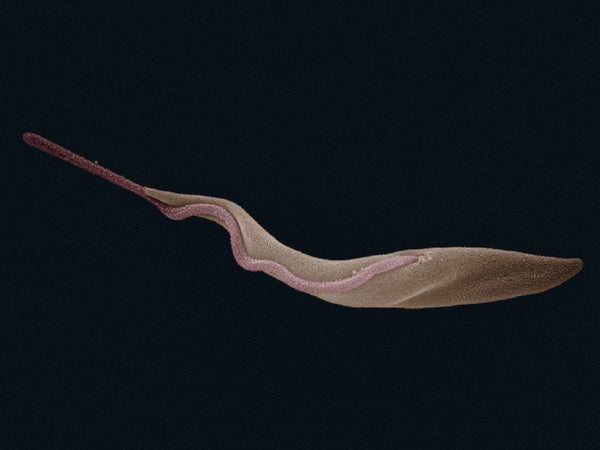
That’s not the case with the disease known as African sleeping sickness, which kills thousands of people a year. Sleeping sickness is caused by a parasite called Trypanosoma brucei gambiense, which can be transmitted to humans by the bite of tsetse flies (species from the genus Glossina). Symptoms of the disease start with fevers and pain but can eventually include lack of coordination, mental confusion, numbness, and (despite the name) inability to sleep. Left untreated, it can lead to organ failure, coma and death.
Luckily, sleeping sickness treatment has a phenomenal success rate when drugs are available. It’s a long process that requires up to two years of post-infection monitoring, and the treatment can cause its own damage and side effects, but it works.
On supporting science journalism
If you're enjoying this article, consider supporting our award-winning journalism by subscribing. By purchasing a subscription you are helping to ensure the future of impactful stories about the discoveries and ideas shaping our world today.
Treatment also doesn’t require the development new drugs every year because the protozoan parasite doesn’t mutate like viruses. It’s always the same. In fact, according to a paper published this week in the journal eLife, T. b. gambiense has stayed exactly the same for something like 10,000 years.
That’s because the parasite doesn’t reproduce sexually. Every individual is basically a clone of every other individual. Not only that, every T. b. gambiense parasite on the planet is apparently a clone of the very first T. b. gambiense parasite, which mutated into existence many millennia ago.
The parasite does still mutate, but researchers found that it rejects any new mutations on the chromosomal level by repairing inferior or mutated genes by “copying and pasting” genes from other chromosomes.
As the paper mentions, asexual organisms have a high risk of extinction because they don’t evolve. That, the researchers write, may eventually be the fate of T. b. gambiense. In fact, the paper suggests that one variation of the parasite, which had previously been detected in Côte d’Ivoire and Burkina Faso, may actually already be extinct as it hasn’t been seen since the 1990s.
In a statement to the media, lead author Willie Weir of the University of Glasgow said this paper could help researchers to develop new treatments for sleeping sickness. That, in turn, could theoretically eventually even lead to the extinction of the parasite. It’s not all that different a scenario than what’s going on today with the Guinea worm (Dracunculus medinensis), a parasitic nematode that is near extinction thanks to the efforts President Jimmy Carter’s foundation, or the cattle disease rinderpest, which was declared extinct in 2011.
The threat of human-caused extinction is the very reason this column exists, and it’s usually a terrible thing, but every once in a rare moon an extinction is something worth celebrating. Maybe one day in the future we’ll be doing just that after the last T. b. gambiense parasite has seen its time on Earth draw to a close.