

This article was published in Scientific American’s former blog network and reflects the views of the author, not necessarily those of Scientific American
A shark species named after a weapon can’t defend itself from the very real risk of extinction.
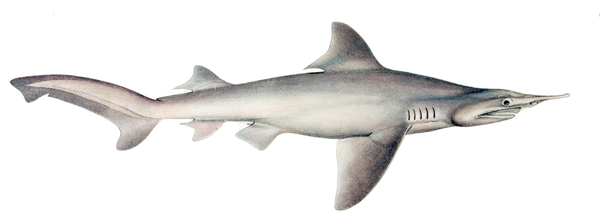
With its pointed proboscis, long jaw and muscular body, South America’s daggernose shark (Isogomphodon oxyrhynchus) looks pretty menacing. In fact, though, it’s a fairly small shark, reaching just about 1.5 meters in length. It specializes in eating small fish that school along the coast, and although that’s completely natural it’s also probably the major reason why the daggernose population has rapidly declined over the past few decades.
You see, the same shallow waters in which the daggernose swims also play host to fleets of fishermen, who all too frequently catch and kill the sharks as bycatch in large gillnets. As a result, daggernose numbers have crashed to just a tiny fraction of their historic levels. Even bycatch numbers have declined by 90 percent since the 1990s. Although the species was declared critically endangered by the IUCN in 2006, it has not recovered and now requires “urgent and effective conservation measures,” according to a paper published recently in the journal Global Ecology and Conservation.
On supporting science journalism
If you're enjoying this article, consider supporting our award-winning journalism by subscribing. By purchasing a subscription you are helping to ensure the future of impactful stories about the discoveries and ideas shaping our world today.
The new study examined the status of daggernose shark populations off the coast of Brazil, one of their primary habitats in northern South America. The researchers, from Universidade Federal Rural de Pernambuco and other Brazilian institutions, found that the majority of sharks killed by gillnets in the 1990s were juveniles, an indication that the species was already facing mortality levels that it could not ultimately survive.
Things have gotten worse since then. Daggernose sharks have been legally protected in Brazil since 2006, but the researchers write that “regulations have never been enforced in Brazil” and that no regulatory mechanisms exist which could help lower the bycatch mortality rate. Meanwhile, gillnet usage in prime daggernose habitat has tripled since 1990, the paper reports.
What’s most telling about this new study is that it mostly relies on shark-capture data that’s now 26 years old. There simply aren’t enough daggernose sharks left to come up with new data about the species’ health and chances of survival. What we do know is that the threats have increased dramatically during the past three decades and that the species continues to decline. The paper concludes that despite limited protections, the daggernose shark is now, without a doubt, within the razor’s edge of extinction and lacking immediate action may soon swim away into memory.
Previously in Extinction Countdown: