
This article was published in Scientific American’s former blog network and reflects the views of the author, not necessarily those of Scientific American
More acidic oceans could soon start dissolving tuna fish as they swim, long before they make it to consumers’ plates.
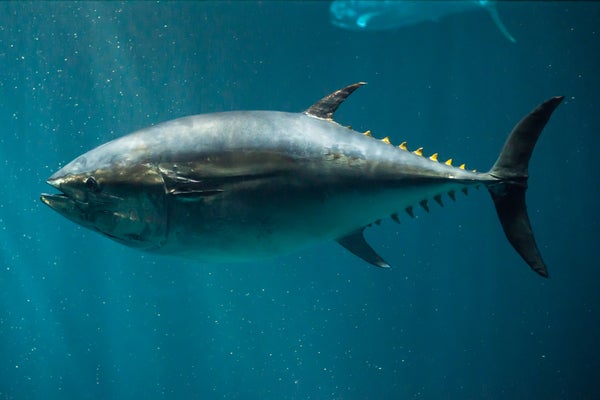
This worrying news comes from a study published last month in the Journal of Experimental Marine Biology and Ecology which found that increasing acidification in the Pacific Ocean—a function of climate change—will cause staggering levels of damage to multiple organs in yellowfin tuna (Thunnus albacares) larvae. The injuries, researchers found, will lessen the tunas’ ability to grow to full size and dramatically reduce their rates of survival.
Yellowfin tuna are already heavily overfished in some parts of the world, so this presents one more challenge to their survival.
On supporting science journalism
If you're enjoying this article, consider supporting our award-winning journalism by subscribing. By purchasing a subscription you are helping to ensure the future of impactful stories about the discoveries and ideas shaping our world today.
For this study, researchers from the University of California at Santa Barbara, the Inter-American Tropical Tuna Commission and other organizations collected yellowfin larvae from a commercial aquaculture bloodstock which is normally exposed to pH levels between 8.27 and 7.74. That’s slightly less acidic then neutral water, which has a pH of 7, but also less acidic than many natural conditions. The larvae were taken then taken to a lab and exposed to waters with four different levels of carbon dioxide, which changed the pH. The first tank, considered the control, had a pH of 8.1. The second had a pH of 7.6, which matches global warming projections for the year 2100, while the third had a pH of 7.3, matching projections for the year 2300. A fourth pH level of 6.9 was considered the “lowest projection for the Pacific Ocean.”
All of that acid added up. The researchers found that it caused damage to the liver, kidney, pancreas, muscle tissue and eyes of the yellowfin larvae—all within a week of exposure. Their growth rates also suffered, ranging from 20 to 41 percent
What does all of that mean? Well, based on the damage to the eyes alone, the researchers concluded that the larvae would have had a mortality rate of between 50 and 100 percent. Even if they survived past those odds, the damage to their kidneys and other organs would have caused all kinds of health conditions later in life, putting them even further at risk.
As the researchers write, anything that causes high mortality rates for yellowfin or other fish in their earliest life stages “will have carry-over effects for marine fish stocks.” They argue that the uncertain future coming as a result of changing water temperatures, dissolved oxygen levels and pH “must be incorporated into future experiments in order to improve the relevance of predictions about the future of fish stocks and their sustainable management.”
In other words: star planning now if you want to keep enjoying tuna in the future.
Previously in Extinction Countdown: