
This article was published in Scientific American’s former blog network and reflects the views of the author, not necessarily those of Scientific American
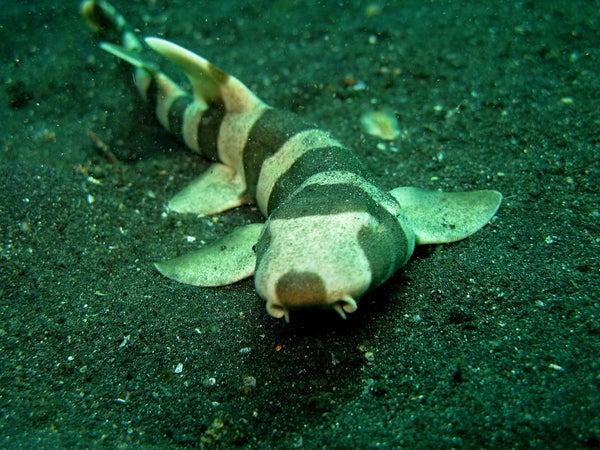
It’s time for conservationists to pick up the pace and protect a group of species known as “walking sharks.”
Walking sharks—nine small, colorful species from the genus Hemiscyllium, also known as “bamboo sharks”—live in the waters around Australia, Papua New Guinea and Australia, where they use their fins to drag themselves around the ocean floor in search of tasty crustaceans. Several of these species, some of which are fairly new to science, were already known to have fairly small ranges, but a new paper published in the Journal of the Ocean Science Foundation reveals that the ranges for all nine walking sharks are actually much smaller than had previously been understood.
The big difference is that the shark species do not have overlapping ranges as had originally been estimated. “In reality,” co-author Mark Erdmann wrote this week for Conservation International’s blog, “we have found that each of the nine species has highly restricted, non-overlapping ranges that form a ring around northern Australia, New Guinea and the satellite Indonesian islands of Raja Ampat, Aru and Halmahera.”
On supporting science journalism
If you're enjoying this article, consider supporting our award-winning journalism by subscribing. By purchasing a subscription you are helping to ensure the future of impactful stories about the discoveries and ideas shaping our world today.
Here’s an example. The distribution for one species, the spectacled carpetshark (H. trispeculare), was previously mapped out as encompassing the entire northern coast of Australia:

Credit: Chris_huh Wikipedia (CC BY-SA 3.0)

The new research, however, finds that the spectacled carpetshark’s distribution only extends roughly to the midway point of Australia’s northern coast, and even there the species only exists in pockets. See the map from the paper below, where this species is marked with black stars:

The restricted ranges, Erdmann wrote, have to do with the sharks’ reproductive cycles. The species all live among coral reefs, where other fish typically broadcast their eggs into the current, allowing each successive generation to drift to new locations. The sharks, on the other hand, lay egg cases which stay in place and don’t allow the resulting young to travel very far. That restricts their distributions.
All of this means that these sharks—none of which are currently listed as endangered—are much more at risk than previously assumed, and much more complicated to protect. Luckily, most live within already existing marine protected areas, but the ongoing problems with many of the world’s coral reefs—including the Great Barrier Reef, home of the epaulette shark (H. ocellatum)—does not bode well for any of these species.
The new research does more than just map out these species’ distributions. It also provides the most comprehensive examination to date of walking sharks’ morphologies and other physical characteristics. The heavily illustrated paper also showcases the remarkable beauty of each of these nine species. As Erdmann wrote, hopefully all of that combined will lead to additional efforts to protect these little-understood but remarkable creatures.
Previously in Extinction Countdown:
Also by John R. Platt