
This article was published in Scientific American’s former blog network and reflects the views of the author, not necessarily those of Scientific American
Like many people, Michael Santiago pictured a white man plowing his fields on a John Deere when he imagined a farmer. That changed in 2014, when he met Mr. James McGill, a third generation African American farmer. At the time, Santiago had moved to Oakland, California to study photography. He connected with Farms to Grow, an organization of black farmers, who introduced him to McGill.
Santiago started photographing McGill and his farm in Bakersfield and began learning about the challenges McGill and other African American farmers face. Santiago’s project,“Stolen Land, Stolen Future,” is the culmination of his work with California’s black farmers. He was awarded the Alexia Foundation student grant for it in 2015, in addition to other accolades.
It’s not surprising that the predominant image of a farmer is a white man with a tractor--only an estimated one percent of America’s farmers are black. It hasn’t always been that way; a complex and often unjust tradition of sharecropping emerged in the South following the end of the Civil War. In it, black families were allowed to rent small portions of land in exchange for a portion of their crop. Although some were able to save the money necessary to buy their land, many others went into debt.
On supporting science journalism
If you're enjoying this article, consider supporting our award-winning journalism by subscribing. By purchasing a subscription you are helping to ensure the future of impactful stories about the discoveries and ideas shaping our world today.
In the 1920s, African American farmers constituted 14 percent of the farmers of the United States but that number has steadily declined over the past century. They also have significantly less land than their white counterparts. Statistics from the United States Department of Agriculture (USDA) found that in 1982 black operated farms were about 100 acres, which is 330 acres less than the national average.
In 1999, the class-action lawsuit Pigford vs. Glickman was filed by 400 black farmers who alleged they were denied loans by the USDA due to racial discrimination. The decision became the largest civil rights settlement in history, with thousands of black farmers being awarded payments up to $50,000 for discrimination claims.

The county is selling this fenced off area that once was owned by the McGill family. Credit: Michael Santiago
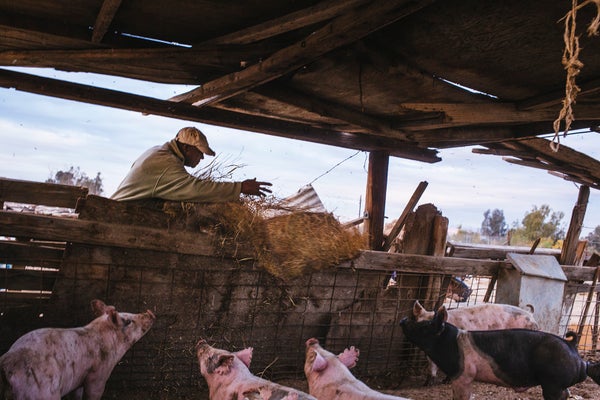
McGill, a third generation farmer, was part of the Pigford lawsuit for his family’s farm. At age 72, he has been farming for over 50 years on the land his grandparents acquired as sharecroppers. After he returned from Vietnam, he had a brief stint as a truckdriver. Then, McGill and a partner owned and operated the 320 acre McGill Farms from 1976-1987.
Now, McGill farms on the only five remaining acres of his family’s land. Santiago explains the property loss can be attributed to foreclosure and being denied loans from the USDA. He says, “It is kind of suspect how it all happened but it basically all comes down to foreclosure. Ever since then, it has just been him trying to keep his head above the water.” Although he has been awarded some small grants that have had a positive short-term impact, McGill does not have the collateral to qualify for loans that could help him make plans for the extended future.
McGill raises pigs and sells about half of the thirty he has every six months at auction for about $200-$300 each. Along with the constant threat of foreclosure, McGill faces the challenge of affording to feed his pigs since rain scarcity and record high temperatures have increased the cost of pig feed.

McGill exercises his prized Duroc and Bluebutt show pigs daily so they will impress the judges at an annual local fair. Credit: Michael Santiago
Still, he loves his work and can’t imagine doing anything else. He does most of the farming himself, though his family does help sometimes. None of them work in farming, so it is unclear what will happen to the farm once McGill can no longer maintain it. For now, his main focus is on the present and keeping his farm out of foreclosure.
Santiago wants to continue his work with McGill and expand to include farmers from other states. Raising awareness of the issue and documenting the farmers’ legacies is what drives him. McGill’s own perseverance has also inspired him. Says Santiago, “This work has encouraged me to continue to tell people’s stories, especially those who have stories to be told that people aren’t hearing.”