
This article was published in Scientific American’s former blog network and reflects the views of the author, not necessarily those of Scientific American
One of my favorite Russian sayings, roughly translated, is that the better your off-road vehicle, the further you’ll have to walk to find a tractor to pull you free when you get stuck.
I consider this phrase regularly during each Blakiston’s fish owl winter field season. We purposefully seek out the hard-to-reach places; the quiet corners of Primorye these secretive owls might be found. We cross narrow mountain passes, struggle through gauntlets of willow along overgrown forest roads, and gun it across rivers of uncertain ice integrity. The waters are not usually very deep, but it’s never pleasant to break through.
Inevitably though, we do find ourselves stuck, or come across others in need of tractors. I spent much of February 2016 looking for fish owls with a team of three Russians led by Sergei, a fish owl veteran and an extremely resourceful fellow in the field. Three instances the past few weeks reminded me of this.
On supporting science journalism
If you're enjoying this article, consider supporting our award-winning journalism by subscribing. By purchasing a subscription you are helping to ensure the future of impactful stories about the discoveries and ideas shaping our world today.
First, as we moved our caravan of snowmobile, four-wheel drive pickup, and industrial-sized Kamaz truck between field sites after a snowstorm, we came upon a plow truck marooned on the side of the federal highway.
It seemed that the snow had drifted in the commanding winds that follow snowstorms here, and the inattentive driver had careened his enormous, plow-crowned vehicle halfway off the steep embankment that buttressed the road. The ruts in the snow and the fatigue in the driver’s eyes showed he had been trying for some time to correct this mistake. The plow was in a tough spot—even a tractor would have had trouble pulling it free—but the Kamaz is bigger than a tractor.
The exchange was almost wordless. Both we and the plow driver understood what had happened and what needed to be done. Sergei eased the Kamaz in line with the stranded plow so that their back sides were facing, and didn’t even get out while the plow driver unfurled a short but thick metal cable and hitched the two trucks with it. Then, the plow driver climbed into his truck shifted into reverse while Sergei inched the Kamaz forward in low gear. The plow was back on the road with a few shuttering tugs.
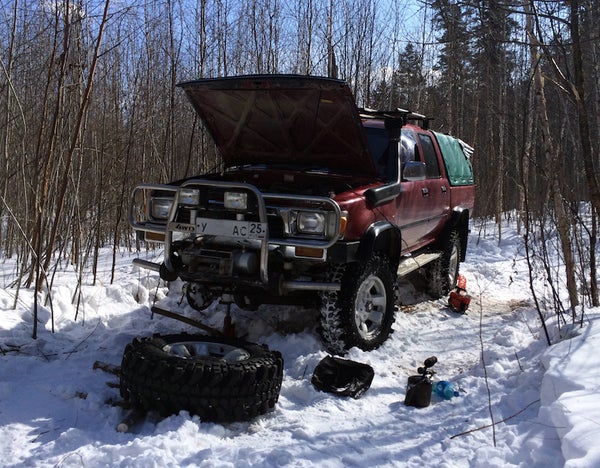
Later, after we’d stationed the Kamaz at our base camp along the Kolumbe River and were accessing smaller roads with the pickup truck, at some point the front driver’s side tire lost pressure. This was not immediately noticed in the deep, granular snow where everything seemed soft.
Then, two kilometers down a trail that was twenty kilometers up a road that was a good eighty kilometers across a mountain divide from the closest mechanic, a snow-buried log jousted the flat tire from its rim. Remounting the tire required tools we did not have.
Sergei did what people here must when a tractor is too far away: he improvised. He removed the tire from the axle and dripped a small amount of gasoline inside the metal tire rim. Then, he wrapped a rag around a twig, lit it aflame, and introduced the fire to the gasoline. The resultant explosion inside the tire instantly reseated the tire bead to the rim. Problem solved. Tractor no longer needed. We inflated the tire and continued on.
Lastly and most recently though, our luck ran out along the Kuruma River. Moments into a thirteen kilometer trip to zero in on a fish owl nest tree, bundled in down and faces covered by masks and goggles, the snowmobile screeched in wounded protest and shuttered to a halt.
I don’t understand exactly what happened but there were ball bearings scattered across the snow and Sergei was swearing with uncharacteristic animation. This was not an easy fix; whatever part needed replacing could likely only be found in Dalnegorsk, a small city four hours to the south.
We coaxed the broken snowmobile back to camp, dropped some weight from our packs and found our headlamps, and continued the thirteen kilometers on foot.
I’m fond of the tractor saying. It’s a reminder that no matter how prepared I think I am, nature will find a way to knock me down a peg. It’s a cautionary warning to take stock of available resources and maintain a mental map of all tractors, be they real or surrogate.
And to gauge how far I’m eventually going to have to walk.
A Russian translation of this post is available
This is the third post in an ongoing series, “East of Siberia,” in which Dr. Jonathan C. Slaght of WCS writes about owls, tigers, and fieldwork in the Russian Far East. Previous installments can be seen here and here.