
This article was published in Scientific American’s former blog network and reflects the views of the author, not necessarily those of Scientific American
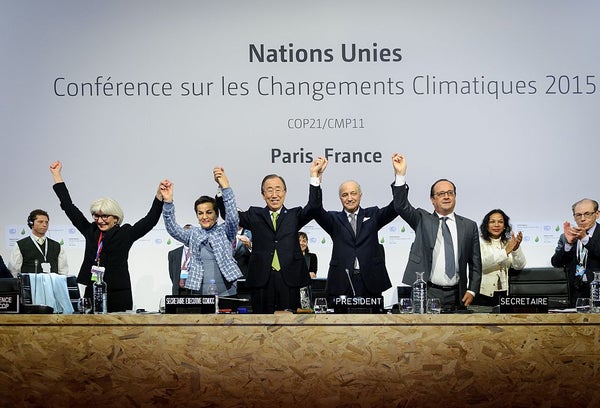
As the world marks Earth Day with the signing of the landmark Paris climate agreement, it is striking that 195 nations have unanimously accepted the findings of climate science—that humans are heating the planet and that something serious must be done about it—but that this science is still called into question by many Americans. Yet only yesterday, Anthony Leiserowitz of Yale reported that 71% of Americans support the idea of the Paris agreement. How can this be?
In realms of science that touch on human affairs, and especially where science is directly linked to policy, public opinion has sometimes diverged widely from the scientific consensus. A growing literature of social science suggests that acceptance of a scientific fact like climate change may be driven by external social factors—group psychology and identity, economic or political interests, or purposeful obfuscation, for example—that are largely separate from the internal processes of science.
Recognizing the challenge, the National Academies of Sciences, Engineering, and Medicine is undertaking a wide-ranging consensus study by a committee of leading scientists to “identify the…factors, media influences, and communications approaches that affect how science relating to a broad range of [controversial] issues (e.g., childhood vaccinations, nanotechnology, climate change, food safety, healthy behaviors) is understood…”or misunderstood.
On supporting science journalism
If you're enjoying this article, consider supporting our award-winning journalism by subscribing. By purchasing a subscription you are helping to ensure the future of impactful stories about the discoveries and ideas shaping our world today.
The study embraces the need to address questions and common elements across many disciplines surrounding public perceptions of science. At the end of February, the committee heard panels of experts offer their views on how the public develops opinions about controversial topics that may conflict with the facts, based on considerations other than the science behind the topic.
This is something we should all care about. America and the world have an enormous stake in assuring that the public trusts the integrity of science and scientists. Rejecting accepted science threatens our society, not only because the enterprise of scientific research has undergirded our enormous technical and material advances since the Enlightenment, but also because it is a foundation of knowledge for improving the human condition that informs social institutions from government to health care to economics.
The greatest motivation for these efforts is a practical one: how can the public reasonably evaluate complicated ideas of science like climate change and public health, which impact their everyday lives and bear on national policy but for which they too often have inaccurate understanding to know what to act on or support?
Take climate change for example. Despite steady growth in scientists’ certainty that we have a warming world because of greenhouse gas emissions, clear exposition of the facts, appeals to the rigor of the scientific process, engaging and inspiring writing, invocations of the overwhelming consensus among climate scientists, and more…despite all this, only about a half of Americans say they think that global warming is mostly human caused (according to Anthony Leiserowitz and Edward Maibach of Yale and George Mason Universities). Does this much doubt, to varying degrees present in other domains like food safety, public health, and teaching evolution as well, suggest something deeper and more complex—an intertwining of scientific fact and social consequences that may result in public distrust of much that scientists think and say?
It is important to try to answer the questions that follow—what factors are known to give rise to public perceptions of science and its credibility, what needs further social science research, how can we apply findings from such research to the practice of communicating science and its consequences? Under the leadership of former AAAS chief executive Alan Leshner, the Academies committee has set an agenda to investigate these and other questions arising from controversies involving science and to report its findings to the public.
Independent foundations and other organizations also have taken up this challenge. The Rita Allen Foundation (through Climate Central), the Packard Foundation, and others have provided support for launching this study. Such groups recognize that effective communication of science is a critical problem in a time when science underlies almost every way that humans relate to their world and to each other.
The committee’s public meetings have already underscored key approaches to science communication—the importance of choosing the right messengers, the role of careful framing and messaging, and the need for repetition and consistency of messages to communicate effectively with the public and policy makers about science that relates to social issues. Several experts have emphasized that knowledge itself matters, even as some activists have called its relevance into question.
This is a promising start. Social science can point to effective ways communicators can help the public distinguish fact from untruth, and hopeful understanding of how science might sidestep contention in the first place. If science communicators can draw on the insights of social science to accomplish this, we may find a path to redemption from what one panelist called the “original sin” of linking public understanding of the facts to policy agendas that many people are reluctant to embrace.