
This article was published in Scientific American’s former blog network and reflects the views of the author, not necessarily those of Scientific American
To promote the international exhibition in the Crystal Palace (Sydenham , London) for New Year's Eve 1853 twenty-one distinguished guests were invited to a banquet inside the unfinished model of an Iguanodon, sculpture made by artist Benjamin Waterhouse Hawkins under severe examination of leading anatomist Richard Owen to celebrate the new discovered proudly-prehistoric monsters of Victorian Britain.
The invitations for the eight course dinner, accompanied by fine wine and some noble sherry, were written on the outstretched wing of a paper-pterodactyl:
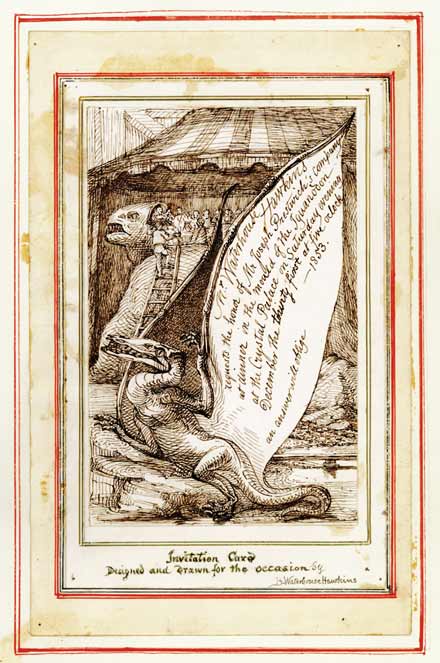
"Mr Waterhous Hawkins requests the honour of - - at dinner in the mould of the Iguanodon at the Crystal Palace on Saturday evening December the 31 st at five o ' clock 1853 an answer will oblige."
On supporting science journalism
If you're enjoying this article, consider supporting our award-winning journalism by subscribing. By purchasing a subscription you are helping to ensure the future of impactful stories about the discoveries and ideas shaping our world today.
Eleven guests could sit inside the belly; ten more places were prepared on a table nearby. The scene was surrounded by ribbons of pink and white brocade and plaques bearing the names of the most eminent palaeontologists of the Victorian time, like Buckland, Cuvier, Mantell and of course Owen as the "Newton of Natural History" and "British Cuvier".
Fig.1. "Dinner in the Iguanodon Model, at the Crystal Palace, Sydenham" London Illustrated News, 7 January 1854 (image in public domain).
The dinner lasted until long after midnight and according to the reports the temper was excellent, Hawkins himself noted:
"The roaring chorus was so fierce and enthusiastic as almost to lead to the belief that the herd of lguanodons were bellowing".
"The jolly old beast
Is not deceased
There ´s life in him again! [ROAR!]"
Many newspapers reported the event the next days.
The Punch reporter, under the headline "Fun in a Fossil", pointed out that Professor Owen and his friends had
"an exceedingly good dinner...[]. . . Had it perhaps been an earlier geological period they might have occupied the Iguanodon's inside without having any dinner there."
And the London Quarterly Review reported mystified:
"Saurians, Pterodactyls all! . . . Dreamed ye ever . . . of a race to come dwelling above your tombs and dining on your ghosts."
Bibliography:
CADBURY, D. (2000): Terrible Lizard - The First Dinosaur Hunters and the Birth of a New Science. Henry Holt & Co. Publisher: 383