
This article was published in Scientific American’s former blog network and reflects the views of the author, not necessarily those of Scientific American
It's probably one of the most famous volcanic eruptions of all times - the 79 A.D. eruption of Mount Vesuvius - so may it surprises that the exact day of this historic event is unknown.
The date of August 24 given in all textbooks is based on two letters from the Roman author Pliny the Younger to Tacitus, a historian who had asked his friend for help to reconstruct the last hours of famous naturalist Pliny the Elder, uncle of Pliny the Younger, who died during the eruption.
However the original letters by Pliny didn't survive into modern times and so the text is only known from transcriptions dating to Medieval times. Already then various versions existed, with different dates (ranging from August to November) or even without any reference at all - this discrepancy can be explained by various translation and transcription errors occurring over time, almost inevitable considering that the eruption happened almost 19 centuries ago.
On supporting science journalism
If you're enjoying this article, consider supporting our award-winning journalism by subscribing. By purchasing a subscription you are helping to ensure the future of impactful stories about the discoveries and ideas shaping our world today.
Some circumstantial evidence suggests in fact a later date for the eruption:
- The famous gypsum-casts show people wearing thick cloths, unusual for August but appropriate for cool temperatures as experienced during an early autumn. Also in many houses portable stoves - ready for use ? - were discovered.
- Despite the fact that the volcanic sediments preserved organic remains very well, typical summer fruits are rare, and autumn fruits, like olives and figs, are abundant in the shops. This could suggest that the Roman shops and stores were buried some time after harvest time, in late October.
- Large jars, used to ferment wine, were discovered already sealed. Considering that the grapes mature in early autumn this observation also could suggest a date for the eruption at the end of October.
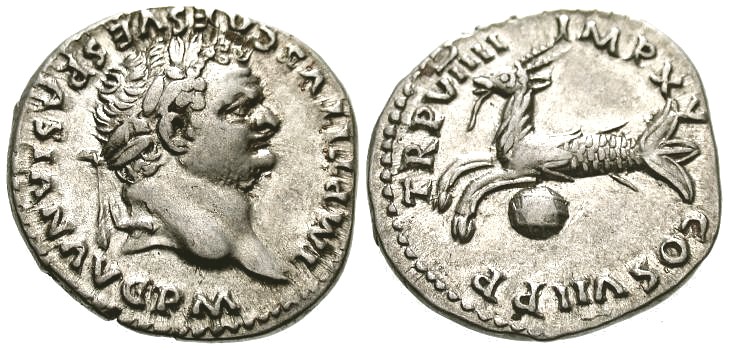
- A coin - a Capricorn Silver Denariusissued by emperor Titus in July - June 79 A.D.- found along the corpse of a woman buried in the ash suggests that the eruption occurred late in summer/early autumn, as the coin would not be in use earlier. However the exact identification of the coin (there exist various editions and the inscriptions of the discovered coin is difficult to read) is in dispute.
- The preserved remains of garum - a spicy fish sauce - made using the fish species Boops boops (bogue), abounding in the Mediterranean Sea from July to August, could also point to a time of the eruption sometime between late August - September, when fishermen could provide fresh fish and manufacturers had enough time (almost a month) to produce the garum.
Also some geological evidence, like the distribution of ash deposits, casts doubt on the August date. The mapped ash layers suggest that during the eruption the wind came from the east. This wind pattern is unusual for the summers in Naples, but dominant in the rest of the year.
A Cold Case in the hot history of volcanoes...
"There are known knowns; there are things we know we know. We also know there are known unknowns; that is to say we know there are some things we do not know. But there are also unknown unknowns - there are things we do not know we don't know."
Donald Rumsfeld, 2002
Bibliography:
STEFANI, G. (2006): Scoperte Campania - La vera data dell´eruzione. ARCHEO 260 - Ottobre: 10-13
ROLANDI, G.; PAONE, A.; LASCIO, M.di & STEFANI, G. (2008): The 79 AD eruption of Somma: The relationship between the date of the eruption and the southeast tephra dispersion. Journal of Volcanological and Geothermal research. Vol. 169(1-2): 87-98