
This article was published in Scientific American’s former blog network and reflects the views of the author, not necessarily those of Scientific American
Not far from my grandmother’s house is a ghost city. At Angel Mounds on the Ohio river about eight miles southeast of Evansville, there are a few visible earthworks and a reconstructed wattle-and-daub barrier. There is almost nothing left of the people who build these mounds; in a final insulting erasure, the site is now named after the white settler family who most recently farmed the land.
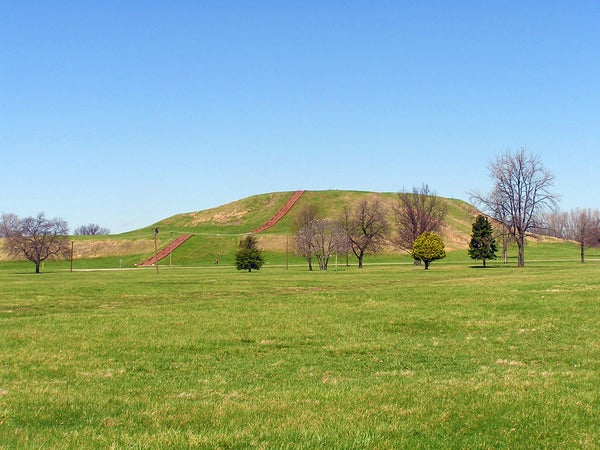
There are traces of other dead villages along the Ohio and Mississippi rivers, mounds scattered from present-day Indiana to Arkansas and Alabama. In southern Illinois, a few miles from the Missouri border, hidden among empty corn and soy fields, is the center of that dead civilization’s gravity: the lost city of Cahokia.
Cahokia was larger than London, centrally planned, the Manhattan of its day. Most people there would have come from somewhere else. There were defensive foundations, playing fields, and a magnificent temple. There would have been sacred ceremonies and salacious gossip. It must have been a very exciting place to live.
On supporting science journalism
If you're enjoying this article, consider supporting our award-winning journalism by subscribing. By purchasing a subscription you are helping to ensure the future of impactful stories about the discoveries and ideas shaping our world today.
And then, relatively abruptly, it ceased to exist. We know of the city only because of the physical traces left behind. Few stories of Cahokia have survived; it disappeared from oral tradition, as if whatever happened to it is best forgotten. The archaeological record shows traces of the desperation and bloodshed that almost always accompany great upheavals: skeletons with bound hands, pits full of strangled young women.
The North American Drought Atlas, a historical record of climate conditions pieced together from the rings of old trees, provides a hint of what might have happened. The tenth century CE, when the Cahokia civilization would have developed, marked a distinct shift in the regional climate from persistent drought to rainier conditions more suitable for agriculture, centralization, and civilization.
But the good times were not to last. In the middle of the fourteenth century, the climate swung back toward drought. This shift was likely associated with shifting temperature patterns in the ocean that affected the jet stream, pulling cool air down from the Arctic and displacing rainfall patterns. These changes are attributable to some combination of natural internal climate variability and externally forced changes from solar activity and increased volcanic eruptions. Their effects were profound.
In Europe around the same time, a confluence of natural factors perhaps related and perhaps separate from the forces drying out the Mississippi Valley caused it to rain heavily in the summer of 1314. The rains continued into the winter, and then into the next year, and then the next. Crops rotted in the fields, and the entire continent went hungry. Contemporaneous historical records complain of rain and famine, villages forced to eat dogs and cats, the dead, and even each other.
The Old World Drought Atlas, a collection of European and Mediterranean trees, shows a period of persistent wetness around the beginning of the 1300s that corroborates these historical accounts. Many of us unwittingly remember the famines in the stories we tell our children. The fairy tale of Hansel and Gretel—hungry children abandoned in a forest haunted by a cannibal witch—almost certainly dates from this time.
Many historical events have happened against a backdrop of natural climate change. Drought in the steppes east of Hungary pushed marauding Huns west and toppled the Roman empire. Volcanic activity suppressed crop yields in pre-revolutionary France, leading hungry, desperate peasants to take drastic action. But climate is almost never the only factor in human history. The Roman empire was overextended and tenuous, torn apart as much by infighting and poor governance as outside enemies. The French underclass starved under the policies imposed by the overclass.
We humans are not passively dragged along by temperatures and rainfall patterns. Climate change did not cause the fall of Cahokia any more than it forced northern Europeans to eat their pets and abandon their children. But the adversity brought by climate change caused societies to break apart, magnified pre-existing divisions, and made desperate people easy prey for dangerous people.
“The climate has changed before,” say people who want to minimize the scale of the current challenge. I have never understood how anyone could find this comforting. The natural climate changes that have shaped human history have almost always been smaller and more regionally contained than the large-scale human-caused change we are currently experiencing. And even these changes have provoked suffering, scapegoating, and the collapse of civilizations.
I am often asked what frightens me most about climate change, whether I lie awake at night thinking about ocean hypoxia or arctic permafrost or other feedback processes that could turn a bad thing into a catastrophe. I am scared of the physical changes that await us on a warming planet, but the most important feedback process is the least well understood. The scariest thing about climate change is what it will make us do to each other.