
This article was published in Scientific American’s former blog network and reflects the views of the author, not necessarily those of Scientific American
A front-page Sunday article in The New York Times, published on December 16th, revealed a recent secret Pentagon program to investigate UFOs. The astounding effort started in 2007, and—according to the US Defense Department—ended in 2012 (though the NYT reporting indicated that, while unfunded, the program remains alive). Perhaps not surprisingly, the covert initiative has failed to produce convincing evidence of extraterrestrial encounters thus far. Instead, most astronomers believe that the mystifying sky sightings, reported by pilots and other military service members, are best explained by optical illusions such as ‘solar mirages’ and the elusive phenomena known as ‘green flashes.’
Green flashes—also known as ‘green rays’—have little to do with particle-beam sci-fi weaponry, but have captivated people’s imaginations for centuries. The French novelist Jules Verne’s fascination with this phenomenon led to his 1882 novel “Le Rayon vert” (The Green Ray), which popularized green flashes to the public. In Verne’s tale, the protagonists are consumed with the idea of witnessing the green ray, but (Spoiler Alert!) they ultimately miss the emerald sighting due to falling in love and looking deeply into each other’s eyes at the pivotal moment—instead of at the horizon.
Aside from a few problematic plot points in Verne’s narrative—such as the incorrect notion that one can reliably predict where and when to see the ray—the green flash is more science than sci-fi, and anybody can observe the phenomenon when the atmospheric conditions are right.
On supporting science journalism
If you're enjoying this article, consider supporting our award-winning journalism by subscribing. By purchasing a subscription you are helping to ensure the future of impactful stories about the discoveries and ideas shaping our world today.
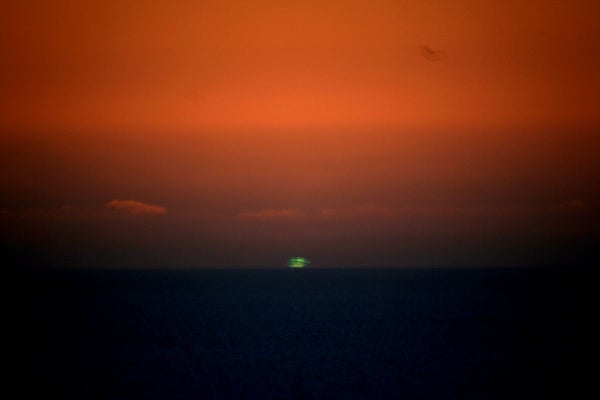
Green flashes appear as atmospheric flares on the horizon during sunset, often lasting no longer than a second or two, on the horizon, right before sunset or immediately after sunrise. Infrequently, a ray may appear to shoot up from the horizon into the sky. Green flashes are most commonly seen at the unobstructed horizon—for example, over the ocean. Pilots tend to observe them when flying west and watching the slowed-down sunset. The phenomenon is an optical illusion, which results from the atmosphere’s layers working as a prism and causing the light from the sun to separate into different colors as it enters, or disappears below, the horizon.

Upper green rim of the setting sun behind the Golden Gate Bridge. Credit: Brocken Inaglory Wikimedia (CC BY-SA 3.0)

In fact, though it can be very hard to appreciate with the naked eye, the thin upper and lower rims of the sun appear respectively green and red at every sunset. Observable green flashes typically happen when mirage effects, in which light rays bend to produce distorted images, boost the illusion. The resulting green oval disks can have the suspicious appearance of alien-origin spacecraft.
Though E.T. may not come to dinner anytime soon, watching a green flash is not unfeasible. All you need is the stars–or at least, our star—to align with propitious atmospheric conditions.

Credit: Champions of Illusion Book