
This article was published in Scientific American’s former blog network and reflects the views of the author, not necessarily those of Scientific American
The Thatcher illusion, discovered 35 years ago by vision scientist Peter Thompson of the University of York in the UK, was essential to current knowledge of face perception. Scientists already knew that faces were difficult to recognize upside down, but the Thatcher illusion went further to demonstrate that the brain does not merely process and store representations of whole faces, but it recognizes isolated facial features such as the mouth and eyes.
The top and bottom rows of Thatcher images are identical but flipped vertically. The top row appears as two regular upside-down Thatchers, but the bottom row appears like a Thatcher on the left and a creepy monster on the right. In reality, the left column contains normal faces (albeit the upper face is upside down), but the right column features composites of Thatcher with only the eyes and mouths flipped vertically. The Thatcher in the upper right appears unchanged, because your face-perception neurons see the eyes and mouth “normal” (even if they do not match the rest of the face). The lower right Thatcher is disturbing because the eyes and mouth are upside down, and therefore all wrong, despite the fact that the face as a whole is right side up.
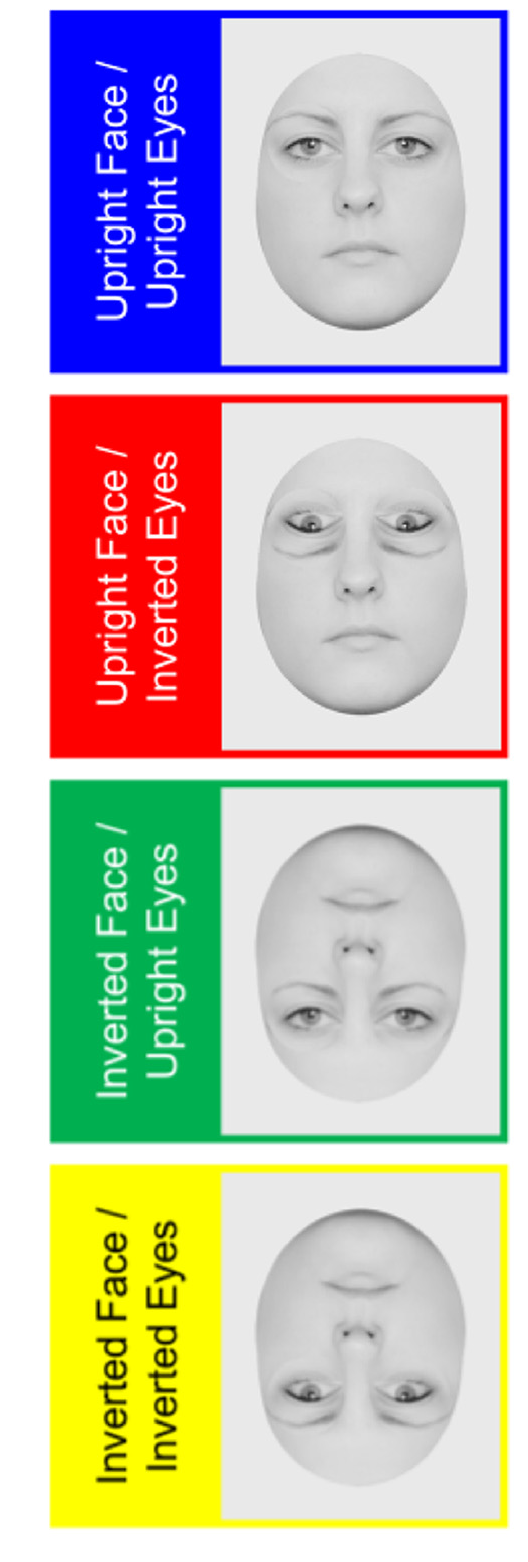
Thatcherized and non-Thatcherized faces presented during neuronal recordings in face-selective brain regions.
On supporting science journalism
If you're enjoying this article, consider supporting our award-winning journalism by subscribing. By purchasing a subscription you are helping to ensure the future of impactful stories about the discoveries and ideas shaping our world today.
Both humans and monkeys notice changes in the orientation of the eyes in a face only when the face is upright, and not when it is upside down. A new study, published earlier this month in the Journal of Neuroscience, has now gone further to determine the potential neural correlates of the Thatcher illusion in the primate visual system.
The researchers used microelectrodes, guided by functional magnetic resonance imaging mapping, to record neuronal activity in several regions of the macaque brain’s face-processing system. At the same time, they presented the primates with upside-down and right-side-up Thatcherized and non-Thatcherized faces.
The neural recordings showed that the responses of neurons in the macaque middle lateral face patch (ML) were consistent with the perception of the Thatcher illusion, but those of neurons in the anterior lateral face patch (AL) were not. In particular, the ML neurons were highly sensitive to eye orientation in upright faces but not in inverted faces, a pattern of response that did not occur in face-selective neurons from other regions. The team concluded that ML is the potential neural seat for the perception of the Thatcher illusion.