
This article was published in Scientific American’s former blog network and reflects the views of the author, not necessarily those of Scientific American
Pathological dinosaur bones usually aren’t pretty. They look gnarly, the bone seeming to bubble or crack in ways that can give paleontologists sympathy pains. But these fossils reveal the terrible lizards more powerfully than any pristine osteological element can. They are moments in dinosaur lives, preserved in petrified detail. One of the latest “dino sores” to make it into the literature is a bitten rib from China’s Jurassic Fengjiahe Formation.
The fossil,
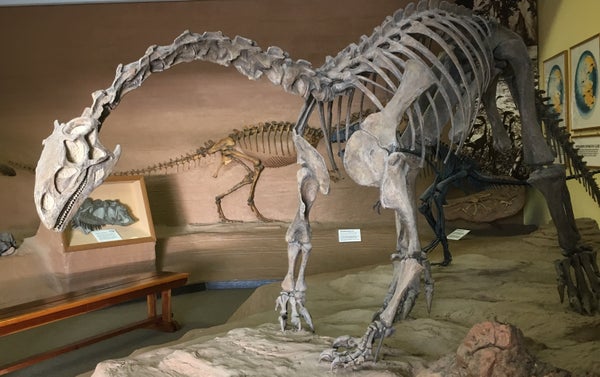
described by paleontologist Lida Xing and colleagues, comes from a specimen of the sauropodomorph Lufengosaurus - one of the long-necked herbivores related to, but mostly predating, our gargantuan favorites like Brontosaurus. This dinosaur definitely knew pain. The third right rib has a strange, partially-healed divot in it. In life, this would have hurt. Xing and coauthors point to signs of osteomyelitis, or a bone infection that probably stemmed from pus-pumping bacteria getting into the bone marrow.
On supporting science journalism
If you're enjoying this article, consider supporting our award-winning journalism by subscribing. By purchasing a subscription you are helping to ensure the future of impactful stories about the discoveries and ideas shaping our world today.
So what happened? This doesn’t look like just any break. Instead, Xing and colleagues propose, the pathology was caused by a puncture - most likely the bite of a carnivorous theropod dinosaur who apparently failed to fell their victim. The Lufengosaurus survived, but the piercing teeth of the carnivore drove bacteria far enough into the bone that infection soon followed even as flesh and bone started to heal. Whether this killed the Lufengosaurus or not is impossible to say, but it certainly didn’t do the dinosaur any favors.
There are always caveats to pathological studies. After all, it can be hard enough to diagnose ailments in living organisms. But whatever actually caused this dinosaur’s pathology, this infected rib makes the Jurassic world feel a little more real. Pristine dinosaur skeletons may be lovely to look at, but elements with pathologies more powerfully testify to what extinct animals experiences. The dinosaur’s pain might not be our own, but it more vividly brings the animal back to life.
