
This article was published in Scientific American’s former blog network and reflects the views of the author, not necessarily those of Scientific American
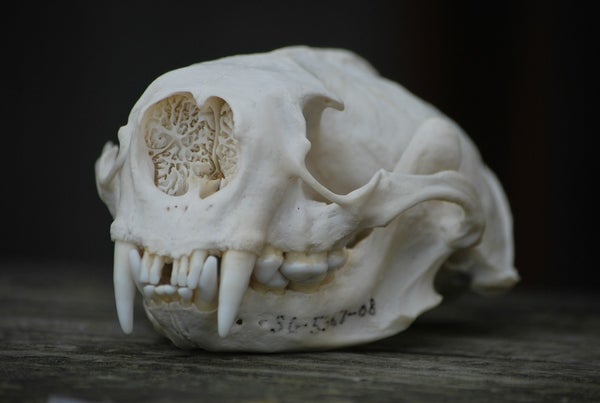
All otters are adorable. That’s as much of a fact as the existence of gravity. But among the 13 or so living otter species, none generate as many awws as Enhydra lutris, the sea otter. These fuzzballs are so cute, in fact, that we often overlook their bad behavior. But what is it that sets them apart? There’s the dense coat of fur and their fastidious dining habits, of course, but they also look a bit different from most other otters. Sea otters have short, round faces compared to their relatives, and that’s all because of their specialist diet. To put it bluntly, a crushing bite has given sea otters an edge over their cute competition.
I'm basing this claim on a paper published this year by zoologists Lori Timm-Davis, Thomas DeWitt, and Christopher Marshall on the two major ways that otters feed. Some otters, like giant and North American river otters, primarily catch fish and other squirmy prey with their jaws, while otters such as Asian small-clawed otters and sea otters often nab mollusks, echinoderms, and other hardened prey with their dexterous hands before crushing through those exterior defenses with expanded cheek teeth. And given that there are trade offs between speed and power in any bite, Timm-Davis and colleagues expected that the differences between these two feeding styles would be visible in the shape of the otters’ skulls. With that in mind, they measured and estimated the bite mechanics for 150 otter skulls representing four different species, as well as parsing out three different populations of sea otters.

A sea otter. Credit: Michael Baird Flickr (CC BY 2.0)
On supporting science journalism
If you're enjoying this article, consider supporting our award-winning journalism by subscribing. By purchasing a subscription you are helping to ensure the future of impactful stories about the discoveries and ideas shaping our world today.
The otters generally met the researchers’ expectations. Giant and North American river otters, which subsist primarily on fish, have longer, narrower skulls suited to fast bites. Just the sort of setup for snapping at slippery and fast-moving prey. The Asian small-clawed and sea otters, which more often rely on plucking up slow-moving invertebrate morsels, have wider, shorter skulls and jaws, delivering a slower but more more powerful bite. Sea otters take this to the extreme, with wide, rounded cheek teeth best suited to pulverizing hard foods.
Not that all sea otters behave the same way, though. When Timm-Davis and coauthors looked at the differences between isolated Russian, northern, and southern sea otters they found that the skulls of each population clustered together in slightly different shapes. This appears to be because of diet. Northern and Russian sea otters diversify their diet a bit by eating more fish than their southern cousins, and this difference shows up in the anatomy of their jaws. Among other variations, the southern sea otters had about 19.1% more crushing surface on their cheek teeth – the better to mash up sea urchins with. These relatively recent changes reflect how quickly differences in diet can start to affect the shape of otter evolution.
For the most part, though, even sea otters with more cosmopolitan tastes still share the deep, short, and wide skull shape that distinguishes them from their lithe relatives. Sure, all that fur, the little nose, and oildrop eyes complete the package, but the mammal’s lutrine looks go down to the bone. Their cuteness comes from their ability to crush.
Reference:
Timm-Davis, L., DeWitt, T., Marshall, C. 2015. Divergent skull morphology supports two trophic specializations in otters (Lutrinae). PLOS ONE. doi: 10.1371/journal.pone.0143236
[This post was originally published at National Geographic.]
