
This article was published in Scientific American’s former blog network and reflects the views of the author, not necessarily those of Scientific American
When I think of dinosaur bones, I think of big, sturdy things. Like the Apatosaurus femur that sits at the end of the oversize collection space at the Natural History Museum of Utah, propped up on a stand. The osteological remnant of the “deceptive lizard” would no doubt break a few of my bones if it fell on me. But my expectation of great reptilian weight comes from what the word dinosaur meant to me when I was very young – something imposing and extinct. Yet birds are living dinosaurs, as I have written about over and over again, and their bones are notoriously delicate. They’re so fragile, in fact, that many fossil birds are only known from isolated bones or broken fragments. But this doesn’t make them unimportant. To the contrary, even a visually unimpressive fossil can tell us a great deal about the history of the dinosaurs who remain with us today.
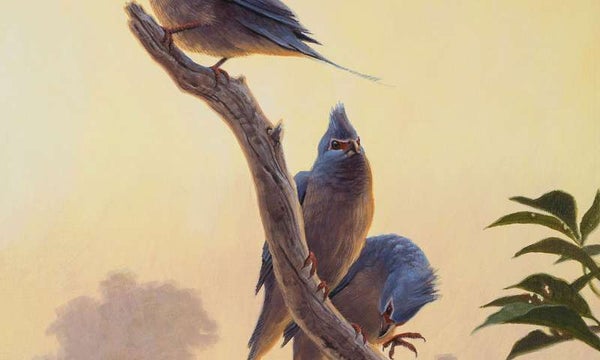
A handful of 62.5 million year old bones found on ancestral Navajo land in New Mexico is the latest example of how big discoveries are about the gaps in our knowledge, not sheer size. These fossils, paleontologist Daniel Ksepka and colleagues report, belong to a new species of prehistoric bird that fluttered around just a few million years after the non-avian dinosaurs were all wiped out by a wayward asteroid. They’ve named it Tsidiiyazhiabini, Navajo for “little morning bird."
Despite the bird’s great age, however, there’s something familiar about it. Among the few bones recovered from the ancient avian is part of the fourth toe. The anatomy of this digit, the researchers found, indicated that it could be turned around backward to hop up trees or grasp perches. This was an arboreal bird. Along with other features, this anatomical detail linked the sparrow-sized Tsidiiyazhi with mousebirds – a group of dusky fliers that still live in Africa today.
On supporting science journalism
If you're enjoying this article, consider supporting our award-winning journalism by subscribing. By purchasing a subscription you are helping to ensure the future of impactful stories about the discoveries and ideas shaping our world today.

The known bones of Tsidiiyazhi. Credit: Thomas Stidham
The bones are a test of what genetic analysis predicted. Genetic studies of when modern bird groups originated and split off from each other had hypothesized that there was a massive surge in avian evolution after the Cretaceous impact that wiped out the non-avian dinosaurs (as well as many other forms of life). Tsidiiyazhi hints that this was indeed the case – not only do the fossils indicate that mousebirds had already originated by 62.5 million years ago, but several other related groups must have split from each other prior to that time in the earliest days of the Paleocene. Mammals weren’t the only creatures having a major evolutionary moment once dinosaurian dominance ended. Birds, the sole carriers of the dinosaurian legacy, rapidly adapted to the brave new world, too.
Reference:
Ksepka, D., Stidham, T., Williamson, T. 2017. Early Paleocene landbird supports rapid phylogenetic and morphological diversification of crown birds after the K-Pg mass extinction. PNAS. doi: 10.1073/pnas.1700188114
