
This article was published in Scientific American’s former blog network and reflects the views of the author, not necessarily those of Scientific American
When I think of mammals from the Age of Dinosaurs, I think of a shrew-like critter snuffling through the nighttime undergrowth. I can’t help it. That’s the meme that museums, books, and documentaries popularized when I was a fossil-crazed kid.
The classic view of the meek mammal eking out a living in a world dominated by dinosaurs is too simplistic, though. Mesozoic mammals are undergoing a renaissance – much like their saurian oppressors got in the 1970s – and have turned out to be far more varied than anyone expected. Mammals of the Triassic, Jurassic, and Cretaceous were small, to be sure, but they counted swimmers, climbers, diggers, gliders, and more in their fuzzy family. They didn’t just live alongside the dinosaurs. They thrived. And among the latest beasties to be added to their ranks is a spiky mammal uncovered from the 125 million year old rock of Spain.

The skeleton of Spinolestes. Credit: University of Chicago
On supporting science journalism
If you're enjoying this article, consider supporting our award-winning journalism by subscribing. By purchasing a subscription you are helping to ensure the future of impactful stories about the discoveries and ideas shaping our world today.
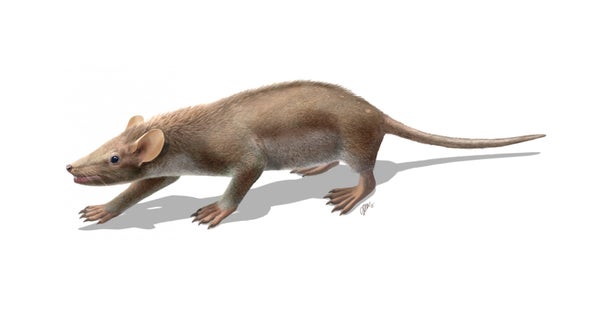
Named Spinolestes xenarthrosus by paleontologist Thomas Martin and colleagues, the mammal belonged to an extinct group called eutriconodonts. The skeleton is about what you’d expect for a little shuffling insectivore. But what makes Spinolestes really special is what surrounded the Cretaceous bones. The critter was preserved with a halo of spine-like hairs.
Spinolestes wasn’t as prickly as a hedgehog. It probably looked a little more like a rat with a midline mohawk of bristles that the researchers term “protospines.” Each of them is made of a combination of several hair-like structures, and are associated with little bits of body armor made of keratin (the same stuff your fingernails are composed of). With the rest of the preserved soft tissue remnants, they show that mammals evolved a multi-layered coat of underfur, guard hairs, and spines relatively early in their history.
Think about that the next time you pet your cat or dog. When you run your hand over their soft coats, you’re touching the past.
Reference:
Martin, T., Marugán-Lobón, J., Vullo, R., Martín-Abad, H., Luo, Z., Buscalioni, A. 2015. A Cretaceous eutriconodont and integument evolution in early mammals. Nature. doi: 10.1038/nature/14905
