
This article was published in Scientific American’s former blog network and reflects the views of the author, not necessarily those of Scientific American
How is Vespersaurus like a horse? This isn’t an intentionally-inscrutable riddle like “Why is a raven like a writing desk?” It’s a real question about the anatomy and habits of an unusual dinosaur that has just stepped into the paleontological spotlight.
Described by paleontologist Max Langer and ten colleagues, the bones of Vespersaurus were recovered from the Cretaceous strata of southern Brazil’s Caiuá Group. Finding a dinosaur here at all is noteworthy. Up until now, the known vertebrates from this slice of time have been lizards, turtles, and pterosaurs. But Vespersaurus is something special even within its strange dinosaurian family.
In the many-branched dinosaurian tree, Vespersaurus is a noasaur. These dinosaurs aren’t exactly household names. The group is a subset of ceratosaurs, the oft-horned theropod dinosaurs made famous by the likes of Ceratosaurus and Carnotaurus. But noasaurs are very different animals. They’re often comparatively small and lanky, with strange skull anatomy. Some, like Masiakasaurus, have forward-pointing teeth thought to be suited to snatching fish. Limusaurus, on the other claw, started off with teeth as a hatchling but lost them all as adults, perhaps indicating that this dinosaur was an herbivore in a mostly-carnivorous family. Now Vespersaurus adds to the array of oddball anatomy.
On supporting science journalism
If you're enjoying this article, consider supporting our award-winning journalism by subscribing. By purchasing a subscription you are helping to ensure the future of impactful stories about the discoveries and ideas shaping our world today.
Working from the assortment of vertebrae, limb bones, skull pieces, and other parts, Langer and coauthors estimate that Vespersaurus was about three feet long in life. And it may have effectively carried its weight on just one toe of each foot.
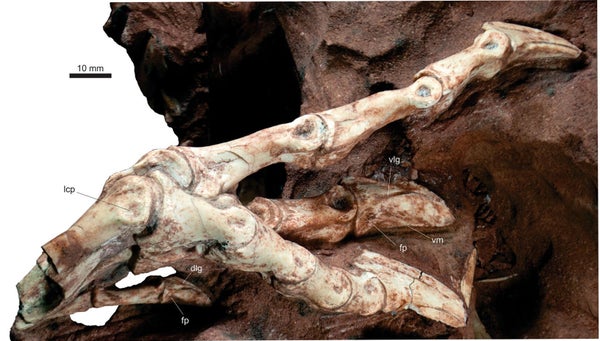
The dinosaur’s pedal proportions offer the salient details. Like most other theropods, Vespersaurus has three forward-facing toes on each foot. But the shafts of the second and fourth metatarsals – the bones of the foot before the toes – are compressed. They bring to mind the reduced splint bones of modern horses that sit to either side of the central, third toe. More than that, Langer and colleagues write, the claws of the second and third toes are also compressed in a similar fashion. When this dinosaur walked, the researchers propose, it was primarily carrying its weight on the third, central toe.
But why did Vespersaurus evolve such a foot? Maybe the local habitat has something to do with it. The Caiuá Group is interpreted as a desert-like, sandy place, and we know that some modern desert-dwellers – like ostriches and rodents called jerboas – have similarly-reduced toes and move around by balancing on a central digit. Might the foot of Vespersaurus be an adaptation related to speed, or an unusual form of movement? Langer and colleagues note that more study is needed, and that the other two toes shouldn’t be totally counted out as irrelevant to the locomotion of the dinosaur, but clearly Vespersaurus was doing something different from most other theropods.
Another form of fossil evidence might provide some clues. Near the place where Vespersaurus was found, as well as other rock units in South America dating as far back as the Jurassic, paleontologists have found the tracks of dinosaurs that appear to have been functionally walking on single, central toes. The interpretation of these traces requires some caution. Experts have to continually ask themselves if they are looking at the track that was pressed into the sediment or an undertrack, stripped of some of the original detail. But if these tracks are what they seem to be, it either indicates a long lineage of strange noasaurs or the repeated evolution of theropods who walked by balancing on single toes. Now the race is on to find the answer.