
This article was published in Scientific American’s former blog network and reflects the views of the author, not necessarily those of Scientific American
Evolution has a greatest hits list. For whatever reason – where chance meets the winnowing force of natural selection – certain forms have evolved over and over again, creating curious trends through the tree of life. Giant, flightless birds seem to be a particular favorite.
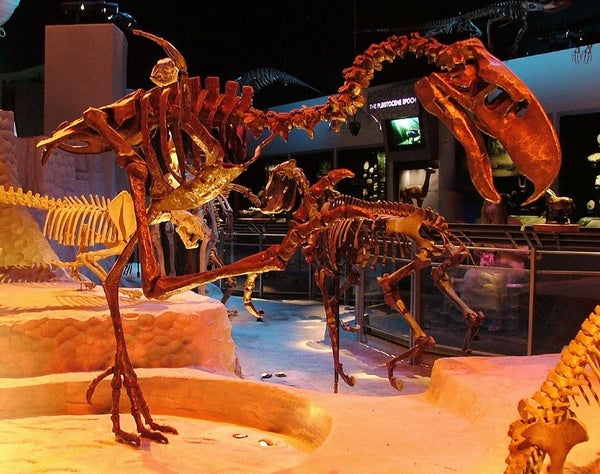
Big birds have evolved repeatedly during the last 66 million years. Some, like Gastornis, were herbivores with big beaks and blunt toes. Others, like the famous terror birds, were fierce carnivores that gave sabercats a run for their money. And then there were the dromornithids, roughly characterized as enormous, flightless ducks. But how these birds evolved and how they’re related to each other – or not – has long been contentious. Unsurprisingly, flying birds giving rise to flightless descendants resulted in a great degree of convergent evolution related to a solely terrestrial life, obscuring phylogenetic guideposts. But, not to be deterred, paleontologist Trevor Worthy and colleagues have taken a new stab at parsing the story of enormous avians.
The focus of the new study is on a group of birds called the Galloanseres – basically landfowl and waterfowl combined. And within this group, giant flightless forms evolved at least three times in the past. In some ways – particularly their legs – they’re especially like elephant birds, moas, and other ratites, taking to the transition from flighted to flightless in similar fashion. But understanding how this happened, and what the ancestors of these strutting birds was like, requires more resolution in how the big birds are related to each other. That’s where the new analysis comes in.
On supporting science journalism
If you're enjoying this article, consider supporting our award-winning journalism by subscribing. By purchasing a subscription you are helping to ensure the future of impactful stories about the discoveries and ideas shaping our world today.
In the big picture, Worthy and colleagues found that two groups of the flightless giants – the dromornithids from Australia and Gastornis and its relatives from North America and Eurasia – fall within their own independent group which the researchers call the Gastornithiformes. Over and over again, members of this group became big and flightless. But these weren’t the only flightless giants. Brontornis – the thunder bird – from South America falls out as a relative of the terror birds, all extinct cousins of today’s seriema.
The new tree highlights that there wasn’t just one path to flightlessness. The big birds of the Gastornithiformes were primarily herbivorous, while Brontornis and the terror birds were either carnivores or omnivores. Why? More fossils are needed to be sure, but Worthy and colleagues propose that the diet of flying ancestors largely determined the habits of their huge descendants. More carnivorous flying avians gave rise to the terror birds and their relatives while fliers with more vegetarian diets set the stage for Gastornis and its kin. In short, there was no single way to eat like a bird, and that led to a variety of feathery giants.
Reference:
Worthy, T., Degrange, F., Handley, W., Lee, M. 2017. The evolution of giant flightless birds and novel phylogenetic relationships for extinct fowl (Aves, Galloanseres). Royal Society Open Science. doi: 10.1098/rsos.170975
