
This article was published in Scientific American’s former blog network and reflects the views of the author, not necessarily those of Scientific American
On supporting science journalism
If you're enjoying this article, consider supporting our award-winning journalism by subscribing. By purchasing a subscription you are helping to ensure the future of impactful stories about the discoveries and ideas shaping our world today.
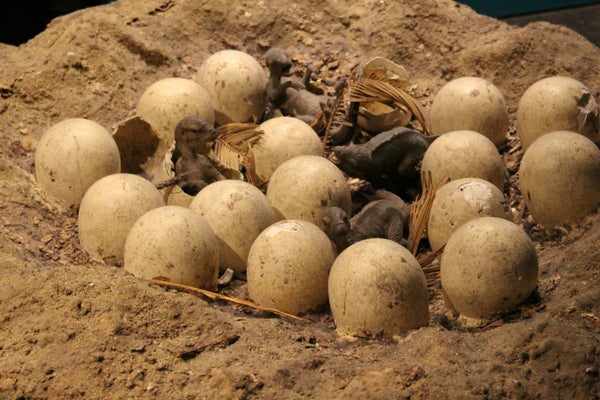
Dinosaurs lived fast and died young. That's the upshot of over a decade of research looking at the way dinosaurs grew up and when they perished. But now this general rule needs a footnote. During their time ensconced in eggs, baby non-avian dinosaurs grew slow.
Even though teeth and bones seem to be static tissues - doubly so after death and fossilization - the fact of the matter is that nearly every piece of a dinosaur's skeleton preserves signs of growth. The bones had to come from somewhere, after all, and the osteological elements of an adult dinosaur had to change in shape and size from the time it was in the egg. Skeletons grow, to put it simply, and that's what allowed paleontologist Gregory Erickson and colleagues to put a timer on how long some dinosaurs stayed inside their eggs.
Eggs containing embryos were the key. That's because the developing dinosaurs had teeth, and those teeth show microscopic lines of daily growth as they accreted. Count the lines and you've got a count of just about how long the baby dinosaurs had been alive. And, as Erickson and colleagues report, embryos of the small horned dinosaur Protoceratops and the bulky hadrosaur Hypacrosaurus preserved this evidence in enamel.
The baby dinosaurs were slow growers. Protocetaops took almost three months to develop, and Hypacrosaurus took nearly six months. This came as a bit of a surprise for animals that have otherwise been interpreted as very active and much more like birds than living reptiles. Today's avian dinosaurs develop in about eleven days to just under three months, yet Protoceratops falls on the outer end of that range and Hypacrosaurus blows right past it.
It's too soon to apply these findings to all dinosaurs. For example, both Protoceratops and Hypacrosaurus were ornithischian dinosaurs from the same side of the family tree. Would the theropod dinosaurs - including carnivores like Allosaurus, the ancestors of birds, and oddballs such as the therizinosaurs - show the same pattern? And what about the long-necked sauropods, marked by their explosive growth rates once out of the shell? More embryos will go a long way to seeing how dinosaurs differed. After all, there's no single way to be a dinosaur. This is a fantastically diverse and long-lived group of animals, each species as different from each other as mammals are today.
Still, if the results mark a sort of dinosaurian standard, the discovery has some broad implications for the ways dinosaurs lived and died. Concerning a long-running debate as to whether polar dinosaurs lived in the High Arctic year round or migrated, Erickson and colleagues point out, the long incubation times of large dinosaur eggs argues against long journeys dictated by the swing of the seasons. It's another line of evidence that polar dinosaurs likely stayed put through the dark, harsh months.
Pull back the focus a little further and the long incubation times might hold a new clue as to why the non-avian dinosaurs died while the bird lineage survived. While there are some advantages to eggs being laid outside the body - for example, removing reproductive constraints that helped some dinosaurs achieve huge sizes far beyond those of mammals - maintaining a nest for months upon months is a tall order. A lot can go wrong, be it a local flood that douses the eggs, raids by egg-hungry predators, or, on a particularly bad day, an asteroid strike that rapidly changes the local conditions. Non-avian dinosaur eggs may have simply taken too long to develop and so eggs laid after the infamous asteroid strike of 66 million years ago never had a chance to grow in a world that went from a shock of heat to prolonged cold and darkness. The particulars of their incubation did not hinder dinosaurian success from the time of the Triassic, but all it took was one really bad day to change the fortunes of Triceratops and company.
Reference:
Erickson, G., Zelenitsky, D., Kay, D., Norell, M. 2016. Dinosaur incubation periods directly determined from growth-line count in embryonic teeth show reptilian-grade development. PNAS. doi: 10.1073/pnas.1613716114