
This article was published in Scientific American’s former blog network and reflects the views of the author, not necessarily those of Scientific American
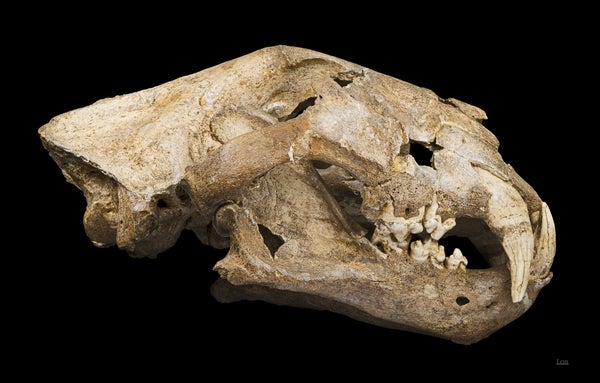
From western Europe to the Yukon, the grasslands of the Northern Hemisphere used to belong to the cave lion. The bones of this massive and maneless cat, larger than today's lion, can be found from the caves of Eurasia to Arctic permafrost. But what were these burly pantherines? Were they something truly distinct, or a variation of the regal felids that roam Africa and India today?
The cave lion, called Panthera spelaea by specialists, has been known to paleontologists for a long time. Naturalist Georg Goldfuss first described the cat back in 1810. Since then, though, experts have disagreed about what the cave lion truly was. Where some experts proposed that the cats were little more than an unusual population of the modern lion, Panthera leo, others elevated the cat up one more step to the level of subspecies, while still others have argued that these fossil felids were a unique species.
Bones have been at the center of this debate, but the cave lion lived so close to us in time that paleontologists can also draw details from the extinct cat's genes. And as paleogeneticist Ross Barnett and colleagues report in a new paper, those little tidbits have bolstered the case that the cave lion was a true species all its own.
Drawing from a 29,860 year old arm bone found in the Yukon and 28,690 year old hair recovered from Russia, Barnett and colleagues were able to assemble the first mitochondrial genome sequences for the long lost cat. By comparing these to genetic sequences from modern lions, leopards, jaguars, snow leopards, tigers, clouded leopards, and domestic cats, the researchers were able to conclude that, yes, the cave lion is a true lion. It's the closest extinct relative of the lions that still prowl around Africa and India today.

Cave lion remains sampled in the new study. Credit: Barnett et al. 2016
Yet, as the fossil bones hinted, the cave lion was not just like Panthera leo. The genetic differences between the cave lion and the modern lion are greater than is typically seen between big cat subspecies. More than that, the researchers note, the cave lion split from its closest leonine relatives earlier than previously thought.
The earliest known cats on the lion line, the researchers write, have been found in the 1.4-1.2 million year old rock of Africa. But lions didn't start to become abundant until much later, with the 680,000 year old Panthera fossilis pioneering the expansion into Eurasia. This cat was supposed to be near the split of cave lions and the lions we know today, but this doesn't appear to be the case any longer. Based on their genetic findings, Barnett and colleagues estimated that the two lion branches separated from each other about 1.89 million years ago, long before Panthera fossilis was on the scene.
On supporting science journalism
If you're enjoying this article, consider supporting our award-winning journalism by subscribing. By purchasing a subscription you are helping to ensure the future of impactful stories about the discoveries and ideas shaping our world today.
"Despite their global range and continued dominance of ecosystems in Africa, and until recently in Asia, the lionlike cats have left a confusing fossil trail," Barnett and colleagues write. The new findings suggest that trail is far longer than anyone previously knew, with Panthera fossilis being a cat comfortably on the cave lion fork rather than something betwixt and between the two evolutionary paths. This also makes the cave lion something much more distinct than the lions we know today - a species of its own, different in anatomy and behavior - and that only salts the wound of its loss so close to us in time.
Reference:
Barnett, R., Zepeda Mendoza, M., Rodrigues Soares, A., Ho, S., Zazula, G., Yamaguchi, N., Shapiro, B., Kirillova, I., Larson, G., Gilbert, T. 2016. Mitogenomics of the extinct cave lion, Panthera spelaea (Goldfuss, 1810), resolve its position within the Panthera cats. Open Quaternary. doi: 10.5334/oq.24

