
This article was published in Scientific American’s former blog network and reflects the views of the author, not necessarily those of Scientific American
Trying to adequately describe Palorchestes is a task that can tax any natural history writer. The beasts are so outside the anatomically expected that even professional paleontologists call them “strange” in their technical papers. That is, after more than a few tries at figuring out what in the world these Ice Age Australian mammals looked like.
The extinct mammals, paleontologist Hazel Richards and colleagues write in a new study, are “known for their odd ‘tapir-like’ crania and distinctive clawed forelimbs.” Slap those traits on a wombat-like body and you more or less get the common image of the animal. But part of the confusion around Palorchestes and its relatives stems from the fact that the majority of the bones in their bodies – almost everything behind the skull – have never received detailed scientific attention. By focusing on the body beyond the cranium, Richards and colleagues have offered a much better look at the confounding beasts.
Palorchestes, the researchers point out, was a late member of a group that goes back over 23 million years. This wasn’t a short-lived family of oddballs, but a group of marsupials with an enviable track record. Figuring out why palorchestids did so well relies on better understanding their anatomy and how they lived, so Richards and coauthors turned to fossil limbs.
On supporting science journalism
If you're enjoying this article, consider supporting our award-winning journalism by subscribing. By purchasing a subscription you are helping to ensure the future of impactful stories about the discoveries and ideas shaping our world today.
In the marsupial family tree, palorchestids were cousins of today’s koalas and wombats – members of a group of vombatiformes. This isn’t to say that palorchestids were just big wombats. This group of mammals was much more disparate in the past, including everything from leopard-like carnivores to wombats the size of a compact car. And the more researchers look at palorchestids, the stranger the mammals seem to become.
Despite paleoart memes that made Palorchestes look like a wombat with a long snout, Richards and colleagues write, newer restorations forgo the tapir snout for a prehensile lip and a long tongue. And these animals could get big. Bigger than expected, in fact. One of the last of their family, Palorchestes azael, could grow to weigh more than a ton. Despite being relatively rare in the fossil record, how herbivores of such size ate, trampled vegetation, and scraped up the ground likely had major implications for their ecosystems.
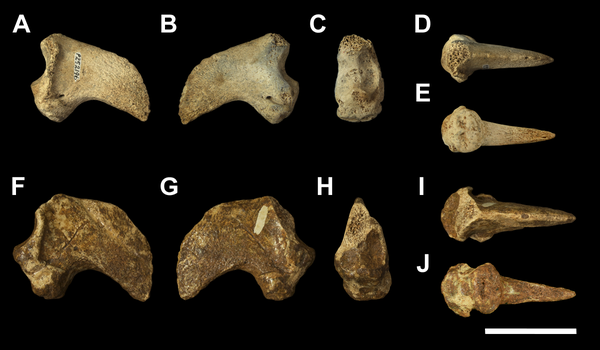
Palorchestids had strong forelimbs. These mammals could dig, grasp, pull, and scratch as they went about browsing for food, Richards and coauthors suggest, with Palorchestes azael taking the trend to an extreme. This species had a locked elbow, unlike any other marsupial ever seen. On top of that, this anatomical arrangement required that Palorchestes had a flexible shoulder with powerful musculature. Why such an arrangement evolved isn’t clear, but Richards and colleagues propose a scenario that would have been as impressive and it was humorous to watch. Perhaps the shoulder arrangement “allowed P. azael to exert a strong bilateral grip on the bole of a tree, grasping with the hands and retracting the shoulder to pull the upper body toward the tree to feed.” Either that, or, as the researchers write, the mammals may have hugged sturdy ferns and cycads and rested their considerable body weight, toppling over the plants and bringing the salad bar to their level.