
This article was published in Scientific American’s former blog network and reflects the views of the author, not necessarily those of Scientific American
Once upon a time, in the Jurassic, there was a turtle. And this turtle got smooshed.
By itself, finding a smashed Mesozoic turtle isn’t especially remarkable. Stumbling upon an “exploded turtle” is a regular part of fieldwork in many places. But the Paléontologie A16 project in the Swiss Jura Mountains found one that appears to have suffered an unusual fate. If paleontologist Christian Püntener and colleagues are correct, they’ve uncovered a rare occurrence of a turtle smashed by a dinosaur.
The turtle in question, assigned to the species Plesiochelysbigleri, was found among strata formed on a Jurassic tidal flat. There are other fossils here. Most are dinosaur tracks belonging to both long-necked, herbivorous sauropod dinosaurs and three-toed theropod dinosaurs. But comparatively few body fossils have turned up at the site, the researchers report, with the smashed Plesiochelys being among the exceptions. And what makes it special is that the turtle was found in layers just below, and close to, dinosaur footprints.
On supporting science journalism
If you're enjoying this article, consider supporting our award-winning journalism by subscribing. By purchasing a subscription you are helping to ensure the future of impactful stories about the discoveries and ideas shaping our world today.
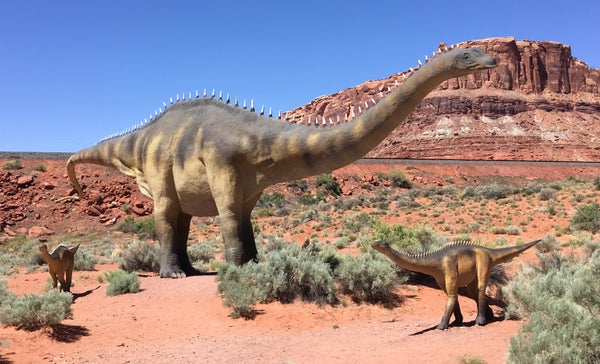
Some of the nearby tracks were made by a sauropod dinosaur not unlike Apatosaurus, a multi-ton plant-eater with broad feet. But the turtle doesn’t appear to be roadkill. Püntener and colleagues suspect that the turtle died out on the tidal flat and was at least partly buried, with the shell holding up better than the rest of the body. Then, at some point later, a wandering sauropod stepped on the sediment above the shell and crushed part of the fossil-in-the-making. Track and shell were both preserved, a time capsule of a passing Jurassic moment.
But could there be another explanation? The fossils are associated with each other, but that doesn’t necessarily mean that they represent an interaction while one of the animals was alive. Püntener and colleagues offer a few lines of evidence to support their case.
Despite being smooshed, the Plesiochelys bones are well-preserved. The turtle shell was not tumbled along or roughly transported from another spot. Some parts of the shell also seem to be rotated in a way consistent with a sauropod step. Large sauropod tracks were found nearby, and seem a good fit for a downward force that could have pulverized part of the shell.
The problem is that the exact place the shell was recovered was not well-mapped, the researchers report, and there is no direct connection between shell and footprint. Not to mention that other forces, like compression of sediment over time, can crush and distort skeletal parts. The connection between turtle and dinosaur is very tempting, but the case isn’t entirely clear-cut. The idea is plausible and entirely within the realm of possibility. Dinosaurs undoubtedly smashed turtle shells, intentionally or not, during the Mesozoic. But this case need a little bit more evidence to bring the scenario to life.
Yet, this is precisely the sort of hypothesis that can fuel images of the past. Even if the actual scenario for this specific fossil isn’t upheld by future study, we can still envision a hefty sauropod ambling over wet sediment, feeling some unexpected crunch beneath a foot before ambling on. The idea both takes us to the past and raises questions about how we can test events we can’t observe in person, a busted shell drawing our imaginations into the Jurassic.