
This article was published in Scientific American’s former blog network and reflects the views of the author, not necessarily those of Scientific American
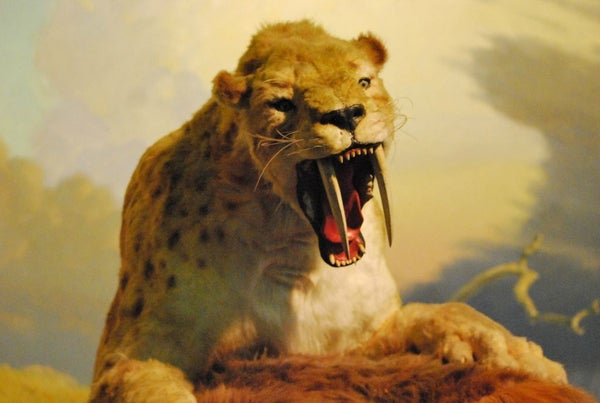
As far as fossil cats are concerned, there is no greater artist than Mauricio Antón. He has a knack for capturing the essence of fossil felids – be it a Homotherium pinning its prey or Dinofelis taking a cat nap – and I love that so many of Antón‘s illustrations feature spots and stripes. The sabercats I saw in books and stop-motion documentaries were never so colorful. They always seemed to wrapped in a relatively plain, dun-colored coat, making Smilodon look like a lion with abnormally-long canines.
Unfortunately, short of finding a frozen sabercat comparable to the steppe lion kittens announced late last year, we’ll probably never know the precise span of sabercat shades. But maybe we can narrow the field a little. Today’s cats, both big and small, might be able to help us predict the presence of spots and stripes in their toothy, extinct relatives.
Today’s cats wear a beautiful array of coat patterns, from plain to dense constellations of spots and stripes. These different color options are largely dictated by two genes – Taqpep and Edn3 – the first of which lays down the general pattern of spots and stripes while the second controls local color differences, like hair banding. But these patterns don’t follow family lines.
On supporting science journalism
If you're enjoying this article, consider supporting our award-winning journalism by subscribing. By purchasing a subscription you are helping to ensure the future of impactful stories about the discoveries and ideas shaping our world today.
Just have a look at Panthera, the genus that includes most of the classic big cat species. There are lions (spots giving way to plain coloration), jaguars (large, filled-in spots), leopards (large open spots), snow leopards (large open spots), and tigers (vertical stripes) all within the same genus. Something else is more important than felid family ties in determining coat colors, and, in a 2010 study, ethologist William Allen and colleagues suggested that the answer is ecology.
After pulling images of 35 wild cat species from the web – because what else is the Internet good for other than cat pictures? – Allen and coauthors analyzed how coat patterns related to different species’ habitat preferences and activity patterns. Cat coats, they realized, “function as a background matching camouflage.” Cats in open, well-lit environments are more likely to have relatively plain coats while those living in forested habitats or active at primarily at night typically have complex patterns of spots and horizontal stripes.

Cats in open environments, like mountain lions, are more likely to have "plain" coats. Photo by K. Fink.
There are some exceptions to this rule. Cheetahs, servals, and black-footed cats have spotted coats despite living in the same type grasslands as lions, while the elusive bay cat has a mostly-uniform coat despite prowling forests. Maybe these discrepancies have something to do with microhabitats or some sort of behavior not parsed in the study, Allen and colleagues write, but for the most part a cat’s coat is more influenced by its ecology than who it's related to.
The same probably held true for the sabercats. So while the forest-dwelling Dinofelis would be more likely to bear spots and stripes, Homotherium and other open-country cats may have lost their spots to be less conspicuous out in the grasslands.
So what about Smilodon? The cat is the ambassador for its long-fanged relatives as well as the Ice Age in general. While we may never know for sure, places like La Brea – where the sabercat is found in abundance – suggest that the iconic sabercat frequented shrubby chaparral. If the ecological connection held, therefore, Smilodon may have worn more subdued hues like the modern mountain lions that live in southern California today, or perhaps it was decked in solid spots much like the cheetah, serval, black-footed cat trio in Africa.
Despite its common nickname saber-toothed tiger, though, we can be pretty sure Smilodon didn’t have vertical stripes. Not only are sabercats and tigers distant relatives, but, as Allen and colleagues found, tigers are the only cats to have vertical stripes on their flanks. Perhaps the best we can hope for is that some Pleistocene artisan was inspired enough by the toothy cats to record their pelage palette for us, a window to an Ice Age world that we just missed.
References:
Allen, W., Cuthill, I., Scott-Samuel, N., Baddeley, R. 2011. Why the leopard got its spots: relating pattern development to ecology in felids. Proceedings of the Royal Society B. doi: 10.1098/rspb.2010.1734
Kaelin, C., Xu, X., Hong, L., David, V., McGowan, K., Schmidt-Küntzel, Roelke, M., Pino, J., Pontius, J., Cooper, G., Manuel, H., Swanson, W., Marker, L., Harper, C., van dyk, A., Yue, B., Mullikin, J., Warren, W., Eizirik, E., Kos, L., O’Brien, S., Barsh, G., Menotti-Raymon, M. 2012. Specifying and sustaining pigmentation patterns in domestic and wild cats. Science. doi: 10.1126/science.1220893
Ortolani, A. 1999. Spots, stripes, tail tips and dark eyes: Predicting the function of carnivore colour patterns using the comparative method. Biological Journal of the Linnean Society. 67: 433-476
[This post was originally published at National Geographic on 12/23/2015]