
This article was published in Scientific American’s former blog network and reflects the views of the author, not necessarily those of Scientific American
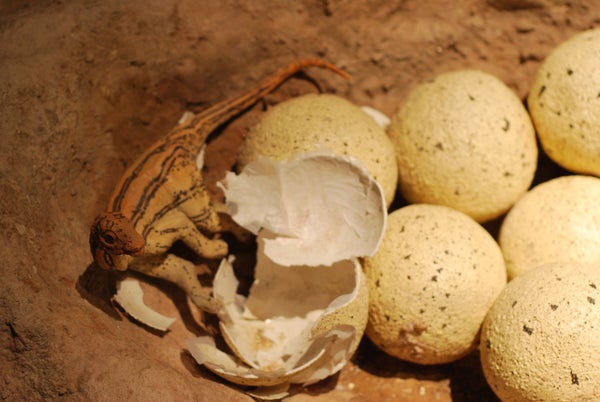
All dinosaurs hatch out of eggs. Every single species – from the enormous Patagotitan to the tiny bee hummingbird – begin life by cracking out of a shell. But not all dinosaurs-to-be make it that far. Sometimes embryonic dinosaurs suffer biological glitches along the way, and a sample of 450 eggs from Cretaceous Europe show that some of the last and largest dinosaurs were having a hard time.
Unless you’re an ornithologist or egg-collector, dystocia probably isn’t a household word. It’s the name of a condition where extra layers are added to an egg, a pathology related to increased retention time within the uterus. And that’s exactly what paleontologists Albert Sellés and colleagues found among fossil eggs of titanosaurs that roamed Europe around 71-70 million years ago.
The eggs, known to experts as a type labeled Megaloolithius, were carried by hefty, herbivorous, long-necked dinosaurs. All were recovered from a swath of land bordering the southern reaches of Spain and France. They can be found in 90 different levels in this region of southwestern Europe spanning 72 to 66 million years ago, the researchers write, but there’s something unusual about the eggs found in the interval around 70 million years ago. There’s a spike in pathological eggs right at this point.
On supporting science journalism
If you're enjoying this article, consider supporting our award-winning journalism by subscribing. By purchasing a subscription you are helping to ensure the future of impactful stories about the discoveries and ideas shaping our world today.
For some reason gravid titanosaurs were retaining their eggs longer than normal in this window of time. The question is why. Sellés and colleagues consider several hypotheses. While it’s possible that dramatic climate changes could have affected dinosaur reproduction, there’s no evidence of such an environmental disturbance at the time. Diet could be another possibility, but – from geochemical signatures related to food and water intake – the affected dinosaurs weren’t under nutritional stress. Instead, Sellés and coauthors suggest, that ecological competition between dinosaurs might be the answer.
The world’s dinosaur fauna was changing around 70 million years ago. This is what zoologists refer to as faunal turnover, when one community is replaced by another. In this case, the titanosaurs, armored dinosaurs, and proto-duckbills were replaced by hadrosaurs and new titanosaurs. Exactly how this stress manifested itself is unclear – was it competition for food, or nesting sites? – but the pathological eggs could be a sign that the established dinosaurs were having a rough time adjusting to the new arrivals. A big dinosaurian story might be hiding in something as small as an egg.
Reference:
Sellés, A., Vila, B., Galobart, A. 2017. Evidence of reproductive stress in titanosaurian sauropods triggered by an increase in ecological competition. Scientific Reports. doi: 10.1038/s41598-017-14255-6
